Elizabeth Cady Stanton Quotes
I think all these reverend gentlemen who insist on the word 'obey' in the marriage service should be removed for a clear violation of the Thirteenth Amendment to the Federal Constitution, which says there shall be neither slavery nor involuntary servitude within the United States.
Stanton, Elizabeth Cady. Eighty Years and More: Reminiscences 1815-1897. European Publishing Company, 1898.


Johnson had a white mistress who accompanied him visibly at a time when Blacks were lynched for dating white women in many parts of the country. He was criticized heavily by whites for going with a white woman and many Blacks for the same.

This relatively radical viewpoint regarding equal rights for women was expressed by Roosevelt as his Senior thesis at Harvard in 1880. In those days, the kind of scrutiny of everything a candidate ever wrote or said that is characteristic of modern politics, did not exist. It is very doubtful that if the Republican Party officials had ever known that he had espoused these views—even as a young student, that he ever would have risen so high in the party, much less get nominated at the Vice Presidential candidate which was his entree to the Presidency. When in office however, there is no record of him reviving his youthful proposal that women who marry retain their maiden names.

There was a national debate ongoing regarding whether two members of the same sex might marry. The Constitutions of several states prohibited discrimination against anyone including gays so that the courts in some cases were called upon to rule on the constitutionality of prohibitions against gay marriage. While nationally, the majority of the people were then opposed to gay marriage, in some states (including Kansas), the majority was vehemently opposed. The American Constitutional system and tradition, almost uniquely protects the rights of minorities from the “tyranny of the majority.” When the Supreme Court ruled that schools must be racially integrated, the majority of the country might have preferred a certain degree of racial discrimination. Brownback on this issue called for the will of the majority to prevail over the minority rights of teh Constitution, but on a woman’s right to abortion which was favored by the majority of Americans, he opposed the tyranny of the majority. The issue politically almost always comes down to "whose ox is gored." A decade later, with a generational shift, the vast majority of Americans suported same sex marriage and the majority of the states legalized and Browbak then claimed the right of the minority (States like Kansas) to not be forced the recognize the marriages that the will of the majority had allowed.


This is a classic example of taking a principle and extrapolating it to an absurd degree. The Supreme Court did rule that there was a right to privacy and did rule that the state could not interfere with most consensual sex in the home including adultery. However the court did not permit bigamy or polygamy, sex with minors, and a host of other areas where the common weal is benefitted. Santorum and others with his view believe that the state should have the right to criminalize adultery and homosexual contact in a private home. And they indeed had this prerogative at earlier times. People were jailed for adultery in Virginia, for having intercourse in different positions in Alabama, for using condoms in Connecticut and others. However, most of the support for these sexual control laws came from religious fundamentalists who wanted the state to enforce their religious beliefs on all. That together with the privacy right, no longer allowed these state abuses if individual freedom. Ironically, most of the advocates for the state’s having the right to restrict sexual freedom. Think of themselves as advocates of individuality and the government not telling folks what to do or how to behave.

Billinghurst was physically handicapped without the use of her legs. She protested and marched in protest parades using a hand propelled tricycle which the police sometimes dumped her out of and left her immobile in alleys.


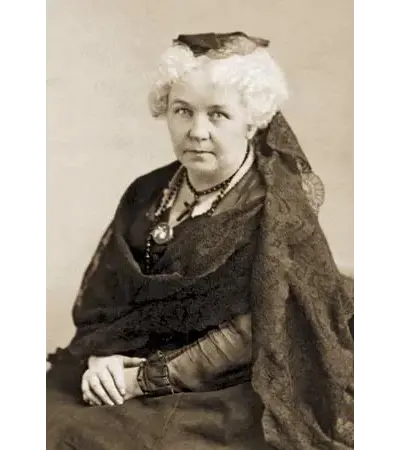
Elizabeth Cady Stanton was a leader of the women's rights movement in the U.S. during the mid- to late-1800s. She was the main force behind the 1848 Seneca Falls Convention, the first convention to be called for the sole purpose of discussing women's rights, and was the primary author of its Declaration of Sentiments. Her demand for women's right to vote generated a controversy at the convention but quickly became a central tenet of the women's movement. She was also active in other social reform activities, especially abolitionism.
