Sam Brownback Quotes
Marriage will be defined in America. It’s just a question of whether it will be defined by the courts of defined by the people.
There was a national debate ongoing regarding whether two members of the same sex might marry. The Constitutions of several states prohibited discrimination against anyone including gays so that the courts in some cases were called upon to rule on the constitutionality of prohibitions against gay marriage. While nationally, the majority of the people were then opposed to gay marriage, in some states (including Kansas), the majority was vehemently opposed. The American Constitutional system and tradition, almost uniquely protects the rights of minorities from the “tyranny of the majority.” When the Supreme Court ruled that schools must be racially integrated, the majority of the country might have preferred a certain degree of racial discrimination. Brownback on this issue called for the will of the majority to prevail over the minority rights of teh Constitution, but on a woman’s right to abortion which was favored by the majority of Americans, he opposed the tyranny of the majority. The issue politically almost always comes down to "whose ox is gored." A decade later, with a generational shift, the vast majority of Americans suported same sex marriage and the majority of the states legalized and Browbak then claimed the right of the minority (States like Kansas) to not be forced the recognize the marriages that the will of the majority had allowed.
Sam Brownback, U. S. Senator (Republican, KS), Speech, April 16, 2005
Sourced by: Eigen's Political and Historical Quotations


His view was that since gay marriage did not affect anyone else but the gay couple, it should not be illegal. This is an early Thomas Jefferson idea (see {604940} ) where Jefferson argues that since it does not effect him or anyone else if a person worships 20 gods or none, he and society has no business legislating against it. Those on the opposite side argued that if someone was an atheist or a pagan, it damaged the culture as a whole and offended their sense of morality. Therefore there must be a state religion. In modern times we are debating the same principle only gay marriage is the subject. Should the majority moral view control all or only those things that directly and negatively affect other people and not their moral sensibilities.


Earlier, he had opposed same sex marriage, but as the population as a whole had a change of mind on this issue, so did he. By 2013, 16 States had modified their laws to allow gay marriage.


This quotation illustrates the brilliance of Scalia. He was in the minority of the Justices when he opposed gay marriage. However, instead of just writing a caustic dissent—which he did—he posed this question to one of the most brilliant attorneys in the country who was arguing the case for gay marriage. Clearly, gay marriage was not considered unconstitutional when the Founding Fathers wrote the Constitution. It is almost certain that no one in those times even considered such a prospect. However, by 2013 a number of states had allowed gay marriage, and the majority of Americans favored it. The best Olsen could answer was “There us no specific data in time. This is an evolutionary cycle”. Despite his oratory tour de force, Scalia was again in the minority and his view did not prevail. Public opinion had clearly changed, and most judges believed that the interpretation of the Constitution most also change and there is no more a specific time to say exactly when that change took place than there is to say exactly when America concluded that the nation should have Prohibition or any other social norm.

At the time he and the Obama administration had favored legal domestic partnerships for gays but opposed same sex marriage. However, he and the President were having moral and legal doubts and there seemed to be an acceptance of homosexuality emerging in society. The administration then changed their position and within just a few years, same sex marriage had become legal in over 10 states and was being politically debated in many others. In many parts of the country, Biden’s prediction came true in much of America, and the change in political and public opinion was occurring in more and more places.


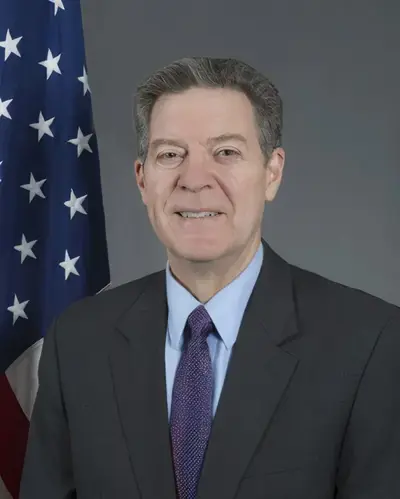
Samuel Dale Brownback is an American attorney, politician, diplomat and member of the Republican Party who served as the United States Ambassador at Large for International Religious Freedom from 2018 to 2021. Brownback previously served as the Secretary of Agriculture of Kansas (1986–93), as the U.S. Representative for Kansas's 2nd congressional district (1995–96), as a United States Senator from Kansas (1996–2011) and the 46th Governor of Kansas (2011–18). He also ran for the Republican nomination for President in 2008.
