Ban Ki-moon Quotes
I strongly reject threats by any member state to destroy another or outrageous attempts to deny historical facts such as the Holocaust.
Ban, Ki-moon. "Secretary-General's Address to the General Assembly." United Nations, United Nations, 25 Sept. 2012.

His view, that America had no vested interest in Rwanda, was the prevailing thinking of the Republicans who controlled Congress and many of the Democrats as well. President Clinton considered intervention in Rwanda, but decided against it given all the opposition and little time to educate the American public to a different position. The result was the genocide in Rwanda where over 500,000 Tutsis were exterminated by the Hutus. Clinton, several years later not only admitted that he made a political and moral mistake, but officially apologized to Rwandan Tutsis who remained alive. He had intervened very successfully in Kosovo to prevent more murder of ethnic Muslims and was given a hard time politically by his opposition even though the brilliant effort cost no American lives. The United States and the UN, all bearing guilt for doing little in Rwanda, did help to set up the mechanism for the trials of the worst murderers and at least many of the most guilty were brought to justice.


Kissinger and Nixon had just had a meeting with Golda Meir, the Israeli Prime Minister who had asked them to support the right of Russian Jews to emigrate to Israel. Kissinger himself was Jewish and Nixon’s closest confidant about world affairs. It is not clear whether or not this was another example of Kissinger pandering to Nixon’s prejudices which he did often. See {621138} for Nixon’s reply. This quotation was uncovered in 2010 when more of the Nixon White House tapes were released.


The United States Senate must ratify all treaties before they can become effective. The Senate has been very reluctant to ratify treaties where the U. S. government or any of its citizens could come under the jurisdiction of any legal entity which did not abide by all the rights citizens are guaranteed by the U. S. Constitution. As a result, we do not recognize the World Court and the Treaty of Rome for example. The latter is the one that gives the World Court jurisdiction over a high level official who commits war crimes even in his own country. The result is that many dictators who do not want to be constrained by international law, do not sign the treaty fending off any pressure to do so by pointing to the United States. But Rothkopf and others who agree with him have not yet been able to come up with a mechanism that will assure American Constitutional rights to Americans who might be involved with the World Court and allow the court to punish the dictators who abuse their own population. The French would like their laws and constitution to control. The Russians, theirs. The Chinese, theirs. Every American public official takes an oath to defend The Constitution. That is their primary duty. Foreign policy and punishing international war criminals must take a lower priority.

The Arab World is made up of many small states who usually vote as a bloc. In addition, most of the other Islamic nations vote with their Arab co-religionists. Since its founding Israel has developed rapidly while the Arab nations have not and some have regressed. Their governments are embarrassed by their lack of progress and blame Israel to mollify their citizens.

Adolf Eichmann was a German Nazi war criminal who had been responsible for the murder of millions of people. At the end of WWII, he had escaped Germany and was living in South America. Israeli agents found him, kidnapped him, and brought him to Israel. There he received a very public trial, was found guilt, and executed. In the War on Terror at the beginning of the 21st century, the key terrorists that were captured in Afghanistan were sent to a special prison base in the American part of Cuba. They were held there but at first received no trials or hearings. They were not prisoners of war, and not criminals where there were legal procedures for handling them. This was a new area. Some argued that they should all get trials. The Supreme court ruled that they at least had to get hearings. The correct handling was a major debate.

Many German officials, after the war, tried to justify the Concentration Camps. However, the argument has little historical merit as by the time the Nazis implemented them, they had complete control of the country and were in no danger of Civil War. And certainly the torture, medical experiments, and murders were not required to prevent civil strife. And using inmates as slave laborers in Donitz’s shipyards had nothing to do with civil war. After the war Donitz was found guilty of Unrestricted Submarine Warfare and using thousands of slave laborers in his shipyards. He was sentenced to 10 years, one of the lightest sentences if the German War Crimes Trials. He himself was not only an enthusiast about the concentration camps but was a murderous anti-Semite as well. See {624978}. The thought that the Germans had to kill little children to avoid civil war is as absurd as any argument could be.


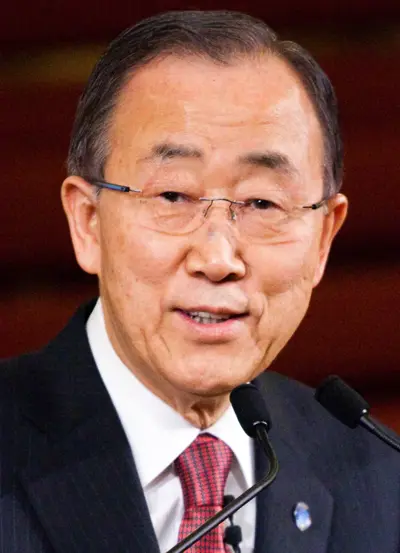
Ban Ki-moon is a South Korean politician and diplomat who served as the eighth Secretary-General of the United Nations from January 2007 to December 2016. Before becoming the Secretary-General, Ban was a career diplomat in South Korea's Ministry of Foreign Affairs and in the United Nations. He entered diplomatic service the year he graduated from university, accepting his first post in New Delhi, India.
