Dwight D. Eisenhower Quotes
I stand for expanded Social Security and more real benefits. Believe me, sir, if I’m president, I’ll give you older folks action not just sympathy.
This was before the Republican Party moved so far to the right. Eisenhower not only supported Social Security where each generation was paid for by the next generation, but he was adamant that the benefits were too low and should be increased. See {623075} for the extent that the Republican party deviated from its roots and traditions,
Dwight D. Eisenhower, 1890-1969, 34th President of the United States (Republican, KS), TV Campaign Commercial, 1952, Quotation Contributed by Bernard Benjamin Yamron from his Brown University 1995 PhD Dissertation, From Whistle-Stops to Polispots: Political Advertising and Presidential Politics in the United States, 1948-1980
Sourced by: Eigen's Political and Historical Quotations

It was not known whether he actually believes such an extreme statement, or he just made it to pander to the extreme right wing of the Republican Party who were a large part of his political base. In effect he was calling the Great Republican Presidents after WWII like Eisenhower a con artist. See {622864}. A Ponzi Scheme is an illegal investment scheme designed so that the early investors get paid by the later investors and the crook running it skims money off the top and has no intention whatso ever to pay off the later investors. It is named after a Bostom Crook who ran the scam in the early 20th century.

18 years later, his son—George W. Bush—made the “nutty idea” one of the main planks in his Presidential legislative program. After the younger Bush traveled the country selling his reform ideas, the public came down on the side of his father and rejected the President’s “nutty idea.”

This is one of the rare occasions where the person appointed to lead a major governmental program, publicy trashed the program and told citizens that they would never receive the benefits that they had already paid for. She was a partisan political appointment who had no real credentials, preparation or previous experience and her statement was so overtly political that few took the statement seriously although there were well known problems that Congress could fix as soon as they have the political will to do so. In the 15 years since this statement not a single worker has failed to obtain any benefits to which he/she was entitled. To see why such a statement can never be made with any certainty, see {619986} which explains the essence of Social Security.


Forseth forgets that in Canada and the United States, as well as most other countries with equivalent systems, the individual worker pays into the Social Security Trust Fund and have paid for their insurance during their working career. Social Security has been solvent so no general welfare money has come into the system. Other conservatives complain that the yield that Social Security pays is not as large as it could be with a private investment and insurance option, so most conservatives do not even think of Social Security as a type of welfare.


This is a classic statement from the Tea Party wing of the Republican Party. Here he not only criticizes the most successful and popular program in American History, but he describes it as a criminal fraud and then claims that Social Security is the biggest threat to our democracy—a bigger threat than Al Qaeda and terrorism, a greater threat than global warming, a greater threat than the housing bubble and the Great Recession. The Tea Party blindness to the effect of these gross exaggerated and obviously false claims is fascinating. He seems totally sincere and yet it is hard for voters to believe that he actually has faith in what he says—although perhaps faith is all he has.


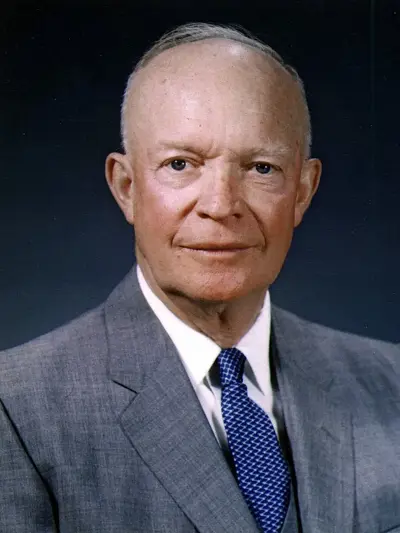
- Born: October 14, 1890
- Died: March 28, 1969
- Nationality: American
- Profession: President
Dwight David "Ike" Eisenhower GCB OM GCS CCLH KC NPk was an American military officer and statesman who served as the 34th president of the United States from 1953 to 1961. During World War II, he became a five-star general in the Army and served as Supreme Commander of the Allied Expeditionary Force in Europe. He was responsible for planning and supervising the invasion of North Africa in Operation Torch in 1942–43 and the successful invasion of Normandy in 1944–45 from the Western Front.
