Ulysses S. Grant Quotes
I propose to fight it out on this line if it takes all summer.
Grant, Ulysses S. Personal Memoirs of U.S. Grant. Vol. 2, Charles L. Webster & Company, 1886, p. 226.


This is one of the great statements in all political history. The nation was in a mess from the Great Depression, few had any hope, and Roosevelt had replaced a President who maintained that the Federal government could not do much about these business cycles. Roosevelt did not have all the answers and of the ones he had, he was not sure they would all be effective. So in two short sentences he conveyed the fact that he will try different things, not all necessarily successful, but a steely determination and commitment to get the job done. And that is just what happened.

The general was expressing a principle that is believed to this day by many policy makers, military people and civilians: Once a war has begun, one must not stop it until victory has been attained. It is unacceptable to negotiate an end to hostilities unless the enemy has been badly beaten on the battlefield. There is this view that “honor” would be lost and that enemies and even allies will not respect you and think the nation is weak and fearful. So there would always be extensive pressure to keep on fighting and not negotiate until there is a military dominant position.

The South could not replenish their lost arms and munitions nor could they replace most of the men wounded, killed or taken prisoner. The Union could do both. Therefore as long as the Union army inflicted casualties, it mattered little who won which battle as long as the fighting was in the South. This critical strategic reality was never appreciated by the Union Generals who were generally reluctant to take large casualties. When Grant and Sherman finally were able to set the strategy of attrition in operation, the Union actually won most of the battles though he and Grant took very high casualties. The casualties of the Confederates were generally higher but they did not have to be for the Union to win. The Civil War was a strategic form of suicide. Ironically, at a few points the rebellion might have succeeded because of the incompetent and timid Union military leadership at the beginning of the war.


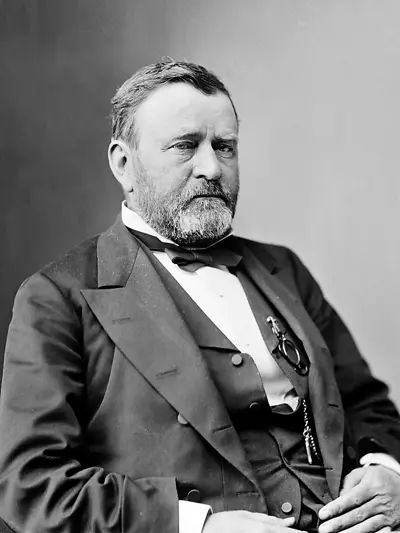
Ulysses S. Grant was an American military leader who served as the 18th president of the United States from 1869 to 1877. As president, Grant was an effective civil rights executive who created the Justice Department and worked with the Radical Republicans during Reconstruction to protect African Americans. As Commanding General, he led the Union Army to victory in the American Civil War in 1865 and thereafter briefly served as Secretary of War.
