Raymond T. Odierno Quotes
I made the decision when I was promoted to colonel that I would no longer vote in national elections because I feel that its my job to serve the Commander in Chief.
Ray Odierno, Army General and Commander of American Forces in Iraq, U. S. Army Chief of Staff, Interview, CBS 60 Minutes, September 28, 2008
Sourced by: Eigen's Political and Historical Quotations


Miles, a hero of the Indian Campaigns (although he led the atrocities at the massacre at Wounded Knee) and then the leading military figure in America was an opponent of the policies of the new young President and had political aspirations of his own for the Presidency. Miles’ opinions were printed in the press. He maintained that he was not speaking as the Commanding General of the Army but personally as a citizen. The President surprised almost all by publicly scolding and reprimanding Miles when he next came to the White House. Five days later Roosevelt made the reprimand official, effectively ending Miles career. The issue of when senior military officers can criticize the administration has been debated ever since. Roosevelt was also a war hero himself, and although the military was shocked by such “savage” treatment of a senior officer, the President had public opinion on his side. Every decade or so there is a military official who does not care for the administration’s policies and expresses himself publicly. President Truman’s firing to General Douglas Macarthur was the most dramatic case, but Truman was well aware of the Miles and TR precedent.


When she was campaigning for women’s suffrage, the famous and prestigious Newspaper Editor, Horace Greeley, publicly challenged her by asking if she was willing to also fight for the country as the men did.

Nominated for Congress while still on active duty in the Union army, Hayes refused to take a furlough to "stump" or "canvass" his district. He wrote: Hayes was nominated for Congress while still on active duty in the Civl War Union army, Hayes refused to take a furlough to "stump" or "canvass" his district.

At the height of the Watergate scandal, the president wanted special prosecutor Archibald Cox fired, because Cox was developing evidence against the president. The attorney general, Elliot Richardson, refused to fire Cox and resigned. The chief of staff then turned to the deputy attorney general, William Ruckelshaus, who also refused and resigned. Finally, the Solicitor General, next in line of authority, agreed to fire the special prosecutor. These events happened on a Saturday night and became known as the “Saturday Night Massacre”. This event persuaded most Americans that Nixon was guilty of felonies and was desperately trying to cover things up. Congress would include “obstruction of justice” in it’s list of crimes that they would have impeached Nixon for had he not resigned.

He was a Republican who served a Democratic President to the distress of some of the extreme right wingers of the Republican Party.

Many of the young men who were given this form to fill out, had never been in Japan and some did not even know there was an emperor there. Nonetheless the Japanese American divisions of enlistees were the most effective and most decorated fighting units for America while their parents who had not been born in America were still imprisoned in the internment camps. See {624010}.


He was reacting to President Donald Trump's demands of Personal Loyalty of his appointees. Trump was a businessman who ran provate (not public) corporations where it was not unusual for the owner to demand personal loyalty of all his key employees. He had not historical knowledge of experience with public service in America where, unlike campaigns, all officials take an oath of loalty to the Constitution and the nation and not to the President. Trump had fired the then FBI Director who was investigationg his campaign for illegal contacts with the Russians, which Trump regarded as an act of disloyalty, especially when the Director refused to pledge his loyalty to Trump.


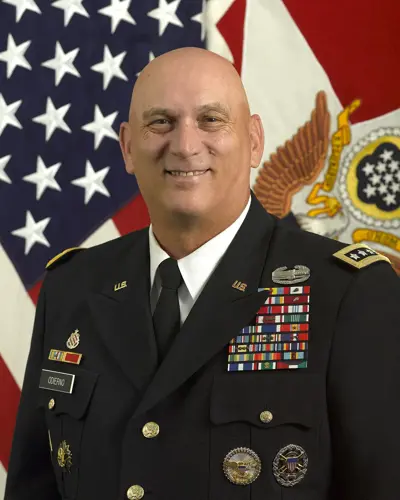
Raymond Thomas "Ray" Odierno is a retired four-star general of the United States Army who served as the 38th Chief of Staff of the Army. Prior to his service as chief of staff, Odierno commanded United States Joint Forces Command from October 2010 until its disestablishment in August 2011. He served as Commanding General, United States Forces – Iraq and its predecessor, Multi-National Force – Iraq, from September 2008 through September 2010.
