Louis V. Gerstner Jr. Quotes
I have never seen American politics so divisive…. We can’t have Congressman not voting for things America needs because it is not popular in their district. We have to put America first.
Louis V. Gerstner, Jr., CEO of American Express and IBM, Interview with Fareed Zacharia, CNN Global Public Square, November 1, 2010
Sourced by: Eigen's Political and Historical Quotations


At the time Congress was gridlocked in bitter hyperpartisan conflict. Most people called for more comity and bipartisanship and most politicians wanted more bipartisanship but blamed the other party for the rift. Mourdock, arguing for less bipartisanship and no compromise defeated Richard Lugar in the Republican Senatorial Primary election. Lugar, one of the most respected and effective Senators was a statesman who worked with any and all to find effective compromises to reach national solutions. The nation was so politically polarized that the Republican Indiana voters ousted one of their most senior senators because he was effective at developing national solutions. See {626717} and {302706} for other Mourdock’s outrageous comments. While this rhetoric won in the Primary, it lost him the general election in a state where Republicans had a strong majority and should have had the seat.


At the time few believed he would not slow down or kill all civil rights legislation as he had done throughout his career. But this is one example of a politician telling the truth on the campaign trail with few believing him. He certainly vindicated his early civil rights record once he became president.


In the 2016 Presidential Elections, there were a few close states. However, in most states one of the candidates won by a signficiant margin proucung some states that supported Trump and some who opposed Trump--hence "Divided States of America".


This is an interesting historical quotation in that the same political environment existed in the first two decades of the 21st century. She was in particular referring to the slander that was commonly used by her fellow Republican, Senator Joseph P. McCarthy in his demagoguery. She was the first member of the Senate to Condemn McCarthy for his abuse and lies. Led by her example, the other senators got over their fear of McCarthy attacking them and the Senate Censured the Demagogue.


2012 and 2013 with the Tea Party driving Republicans more to the right under fear of being attacked in their primary elections caused the handful to shrink to 2 or 3. The change stems from the historical fact that the majority of the Democratic racists (mostly of the South) were furious that their party, had passed the Civil Rights Act of 1964 ending legal segregation and institutional racism of the South. The Republicans implemented a “Southern Strategy” by using code words that endorsed Southern racism and this swung the formerly Democratic “Solid” South to the Republican side changing the balance of power for years. The conservative Democrats became Republicans changing the balance in that party. The conservatives starting purging the liberal Republicans and then drove many of the moderates out. Meanwhile, the Democrats, without their conservative wing from the South became more left wing and made things uncomfortable for the remaining conservatives. Just as Tama predicted there were few moderates left to cross over and vote with the other party. Congress became totally dysfunctional.

This was a new political phenomenon where a President was perceived as more important, more powerful, and preferable to his party. Note that the base of the scale is labeled “Public Opinion”.

At the time, the Republicans held the House of Representatives, but not the Senate or the Presidency. By popular vote, even the House elections had the majority voting for the Democrats, but the gerrymandering gave the Republicans more seats. A minority of the minority Republicans were Tea Party Republicans—ultra conservatives who would not compromise but who intimidated other Republicans by threatening to run candidates against them in primary elections. The result was that the Tea Party Republicans—a minority of the minority could block almost any legislation and did. That Congress passed less legislation than any in American history including the “Do Nothing Congress” of the Truman era.


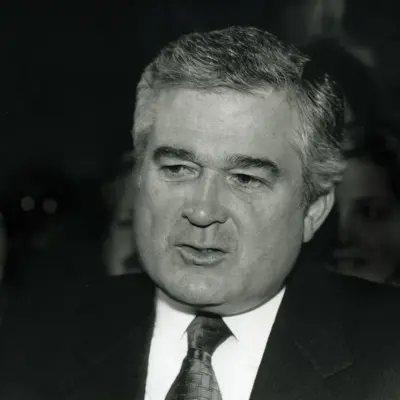
Louis Vincent Gerstner Jr. is an American businessman, best known for his tenure as chairman of the board and chief executive officer of IBM from April 1993 until 2002, when he retired as CEO in March and chairman in December. He is largely credited with turning IBM's fortunes around.
