Norris H. Cotton Quotes
I don't propose to let either the NAM [National Association of Manufacturers] or labor unions hand me a bill and say: "Take it or leave it.
Norris was a member of the U. S. House of Representatives when the Taft-Hartley Act was debated. The pressure was intense. He told union leaders in his district:
Norris H. Cotton, 1901-1989, U. S. Congressman & U. S. Senator (Republican, NH), Quoted in his obituary, The Washington Post, February 25, 1989
Sourced by: Eigen's Political and Historical Quotations


With the large number of jobs that are going overseas, and the increasing productivity, the economics of the late 20th century and early 21st century made job security an anachronism. Therefore the unions were weakened.


After a CIO retail clerks’ union led a strike against Montgomery Ward, Bridges’ union declared that their union and other unions should oppose any labor strikes during World War II.


At the time, most company owners and managers refused to bargain collectively with employee elected organizations. Hoover was then an exceptionally modern business person who realized the importance of good working relations between management and labor and advocated collective bargaining. However, as he got deeper into partisan politics, he backed off urging this. Nationally, in the 1960s collective bargaining had become an instrument of basic sound management, but more and more managements returned to simply refusing to bargain with employee organizations and instead strengthened their managers and supervisors and adopted (by choice and by government regulation) more and more modern, healthy, safe, efficient and attractive working conditions and policies. By the 21st century, labor unions and employee organizations had lost their attractiveness while managers were more attentive to workers and there were very few private companies engaged in collective bargaining.


This was praise indeed as Wellman was generally very conservative.


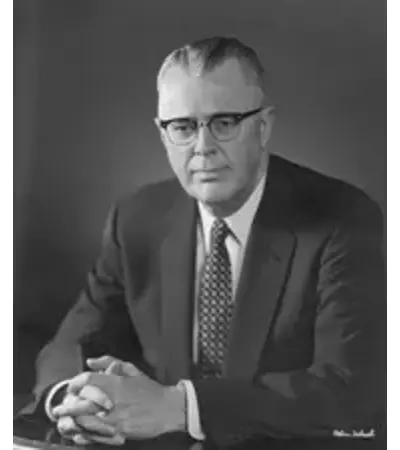
Norris Henry Cotton was an American politician from the state of New Hampshire. A member of the Republican Party, he served as a U.S. Representative and subsequently as a U.S. Senator.
