John Adams Quotes
I do not know what to make of a republic of 30 million atheists.
John Adams, 1735-1826, 2nd President of the United States (Federalist, MA), Reaction to the French Revolution and the Age of Reason
Sourced by: Eigen's Political and Historical Quotations


The phrase ‘This would be the best of all possible worlds, if there were no religion at all!!!’ is often quoted to imply that Adams was opposed to religion. This is a classic use of using quotations out of context for if one reads the entire quotation, Adams is stating that without religion the world would not be a particularly fit place. Some religionists then use the entire quotation to argue that Adams was a religious, Christian man who saw America as a Christian nation. That too is out of the context of the totality of his views—see {592753}.


Philip II, by this statement, and his subsequent behavior, made a major step forward in France for the separation of church and state. Previously, French kings played a major part in the selection of the bishops and other high clerics of the realm. Phillip ceased that type of interference. He did however, close down a religious commune for misbehavior, but that was at the request of both the church and civil authorities. See {617074} . The religious authorities at the time were delighted with this form of separation of church and state, but they were adamant that their church should be able to influence the monarchy and laws of the realm. In contrast today, the Chinese government does not allow any religion to interfere with the operation of the government, but insists that the Dali Lama and the Bishops of the Catholic church can only be appointed with their approval. Separation of church and state is a two way phenomenon.

The colonial American were quite knowledgeable about trials like this one which were occuring all over Europe. The result was the demand for the First Amendment in order to ratify the original Constitution. In this particular case, the major crime that triggered the investigation and trial was the fact that La Barre did not remove his hat in respect as a religiohs procession of Corpus Christi went by. During the investigation, the mayor searched La Barre’s residence and found blasphemous literature the worst of which appeared to be Voltaire’s Philosophical Dictionary which the Mayor ordered to be burned along with the head and body. The photo is a plaque in Abbeville to the victim reminding all of the danger of mixing religion in civil law.


When the priest died, 3 handwritten manuscripts were found written and signed by him in which he attacked religion in general and the church and the Bible in particular. His Testament was read by Voltaire and Denis Diderot among others and he was very influential in their development as opponents of organized religion. This quotation has been one of the bases of secular humanism which would then develop after he had died.

He was an overt atheist; there were many non believers in Europe at the time but few were overt. He also wrote under the name of Jean Baptiste de Mirabaud.


This is a remarkable quotation in that it shows us that there was virtual unanimity about the separation of church and state including the various clergy who were in support of it. Yet in the 21st century there was considerable controversy among some fundamentalist groups who sought more religious influence and/or control of government policy and criminal laws.

Here we have an example of a government that tried to go into the Religion business. They wanted Christian religion but not the Catholic Church which at the time was the only Christian church. Many of the most extreme French revolutionists had a problem with religion. They were personally believers and recognized that most French people were. But the organized Roman Catholic Church was a major ally and supporter of the hated monarchy, and at the time was extremely corrupt at the expense of the people. The nobility were also the highest officials of the church in France. One solution they tried was to have the “people’s government” establish days and methods of worship, an effort that in retrospect appears ludicrous to us today.

This is a critical quotation on the government establishment of religion issue. There are a few people who have argued over the years that the Founding Fathers and their culture was religious and where they were careful to avoid favoring one religion over another, they did NOT intend to put atheism on the same equal plane as religion as far as government action is concerned. However, some of the Founding Fathers were atheists, and some others like John Adams were deists—they believed in a God but not in the Trinity or in Judaism or any organized religion. So this quotation makes it clear that the First Amendment does NOT favor religion over non religion or secularism. Atheism must be on an equal footing but not on a higher plane.

This is a critical quotation on the government establishment of religion issue. There are a few people who have argued over the years that the Founding Fathers and their culture was religious and where they were careful to avoid favoring one religion over another, they did NOT intend to put atheism on the same equal plane as religion as far as government action is concerned. However, some of the Founding Fathers were atheists, and some others like John Adams were deists—they believed in a God but not in the Trinity or in Judaism or any organized religion. So this quotation makes it clear that the First Amendment does NOT favor religion over non religion or secularism. Atheism must be on an equal footing but not on a higher plane.

Bush was trying to obtain the Republican Presidential Nomination and that party had come under the influence of Protestant Evangelicals who could in effect veto any candidate in the Primary election. Bush, who was already suspect with the Evangelicals, chose to make this statement with the full knowledge that there is no Constitutional citizenship requirement to believe in a god and that a number of the leading founding patriots and founders had been atheists. However his tactics were successful and the following year he was the Republican nominee. Despite this statement, he never acted on it or made it a part of his administration’s principles. Politicians are often placed in these difficult positions where they are pressured into positions not to their liking in order to politically succeed. In this case, he never did more than make the disgraceful statement. He did not adopt any policy of take any action. However, this quotation is unique in American history as the only time an American president ever stated that American citizenship should not be recognized for religious reasons only.


American Atheists is a non-profit organization which represents atheists.
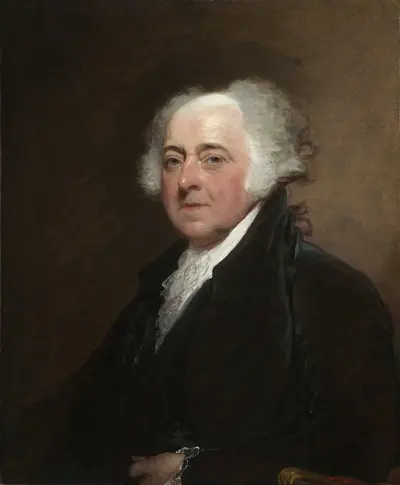
John Adams Jr. was an American statesman, attorney, diplomat, writer, and Founding Father who served as the second president of the United States from 1797 to 1801. Before his presidency, he was a leader of the American Revolution that achieved independence from Great Britain, and he served as the first vice president of the United States. Adams was a dedicated diarist and regularly corresponded with many important figures in early American history, including his wife and adviser Abigail Adams and Thomas Jefferson.
