Dewey Jackson Short Quotes
I deeply and sincerely regret that this body has degenerated into a supine, subservient, soporific, superfluous, supercilious, pusillanimous body of nitwits, the greatest ever gathered beneath the dome of our National Capitol, who cowardly abdicate their powers and, in violation of their oaths to protect and defend the Constitution against all of the Nation's enemies, both foreign and domestic, turn over these constitutional prerogatives, not only granted but imposed upon them, to a group of tax-eating, conceited autocratic bureaucrats a bunch of theoretical, intellectual, professorial nincompoops out of Columbia University, at the other end of Pennsylvania Avenue who were never elected by the American people to any office and who are responsible to no constituency. These brain trusters and 'new dealers' are the ones who wrote this resolution, instead of the Members of this House whose duty it is, and whose sole duty it is, to draft legislation.
Short was a "Tea Party Republican" long before there was a Tea Party. He was a virulent opponent of FDR, the New Deal, and the Roosevelt Brain Trust. The anti intellectualism was even then not new. Long before Donald Trump and the Tea Party of 2016, there were conservatives who constantly attacked the unelected government appointees and Presidenial Advisors.
Dewey Jackson Short, Speech, the U.S. House of Representatives on January 23, 1935.
Sourced by: Eigen's Political and Historical Quotations

Ex HEW Secretary John Gardner, the founder of the citizens' lobby, Common Cause, was testifying before Hays' committee: Gardner, considered an excellent Secretary by most, was a reformer who was making some suggestions not to Hays’ liking. This quote was Hays’ reposponse to Gardner. Hays was not only a bully but his lack of tact caused the State Departmemt much trouble. See {622348}.


This is one of the earliest examples of the phrase “do nothing Congress” which Harry S Truman made so famous in his re-election campaign. Clearly Linney did not originate the phrase but his may be the earliest documented usage.

Harry Hopkins was the special assistant to President Franklin Delano Roosevelt through the two great American crises, the Great Depression and World War II. Although he was a social worker with not a shred of political experience, Hopkins was originally selected by the President to operate the national relief program in the midst of the Great Depression. Soon he had spent more money than any human being in history without a taint of scandal. He had never been elected nor was he even ratified by the Senate. He also paid virtually no attention to members of Congress as he became the most successful manager in American Government history. Soon he became FDR’s most important aid. Then he and his wife actually moved into the White House and lived there with the Roosevelts and was a favorite of not only FDR but Eleanor Roosevelt as well. When WWII began the leading military and diplomatic leaders advised the President not to provide military aid to England or Russia believing that these countries could not hold out and the weapons would fall into German hands and be used against American soldiers. Roosevelt sent Hopkins to Europe to assess the military situation despite the fact that he had never had a single day of military experience. When his war advice contradicted that of the leading generals and admirals, many people were scandalized, especially when FDR took Hopkin’s advice above that of the generals and diplomats. Massive assistance was sent to those countries and indeed both were able to hold out just as Hopkins had predicted. No one in American politics before or since had that much influence or power. Most historians see that particular phenomenon as a unique combination of two extraordinary men at an extraordinary time and virtually impossible to replicate.


Samuel Langhorne Clemens, 1835-1910

A trochar was a medical instrument commonly used with cattle when they would become very bloated with gas. The farmer would insert the trochar into the the animal and all the gas would come out with a loud noise. The insult was understood by farmers, ranchers, and rural folk but went over the heads of must city people and journalists.

Congress at that time had about a 12 percent public approval rating. Other emergency disaster appropriations had been made in previous years in days or weeks, but the aid for New Jersey, New York and Connecticut had been voted by the Democratic-controlled Senate but not in the Republican controlled House. The Republican House leadership had planned a vote after the Fiscal Cliff vote the previous evening before the end of the Congressional term. Then the speaker cancelled the vote infuriating Christie and many of the members of Congress. His reason was that there was opposition from the Tea Party Conservative wing of his own party who had just been badly beaten on the fiscal cliff legislation, and the Speaker was up for reelection by his own party caucus the following day. If the vote had proceeded, it would have passed with Democratic and some Republican support but with the opposition of the conservative wing some of whom noted that the states seeking the emergency aid had just recently voted for President Obama and they were opposed to more federal spending despite the fact that emergency aid had never before been subjected to such partisan criteria. After much pressure, the Speaker then committed to an up or down vote in the following Congress to the chagrin of some of the Tea Party members. Governor Christie, much admired for his commitment to his state and not politicking was his candid self but he did not even go as far as Republican Congressman Peter King {630995}.


His admonition did little good. That Congress passed fewer bills than any other in history.

_0_thumbnail_47x47.jpg)


Chief legal officer of a Dutch town. He wanted to have a plebiscite in each town on major issues before the assembly so as to instruct the representative as to how to vote. The graphic is a painting of Adriaan van Zeebergh and his board of the Teylers Stichting.

President Ford forced him to resign. He had been a holdover from the Nixon Administration. Ford did not chooses him. Nixon appointed him on the advice of the ultra conservatives in the party who liked the fact that he wanted to dismantle many of the FDR New Deal policies. However, he came from Indiana which was the lost racist of all the Northern States. In the 1920s Indiana had the largest membership in the KKK of any state in the Union, and Butz came from this line of racists. He also was convicted for Federal Tax Evasion.


1st Earl of Oxford. While clearly a gross overgeneralization, the Austrian leadership were in the process of making some very stupid policy decisions that led to WW I and the destruction and breakup of their empire.

Kobach had told the public that “illegal; voting” was a big problem in Kansas. See {642279}. The GAO report found that there had been hardly any problem at all.
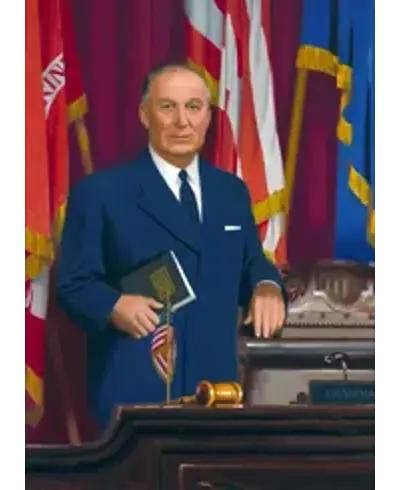
Dewey Jackson Short was a Republican U.S. Representative from Missouri's 7th congressional district for 12 terms and a staunch opponent of President Franklin Delano Roosevelt's New Deal.
