Ron Paul Quotes
I am convinced that there are more threats to American liberty within the 10 mile radius of my office on Capitol Hill than there are on the rest of the globe.
Ronald E. Paul, U.S. Congressman (Republican, TX), Libertarian Nominee for President, Texas Straight Talk: On Reinstating the Draft, February 16, 2009
Sourced by: Eigen's Political and Historical Quotations


Berger, an elected Congressman, was denied his seat after he had written an editorial against the First World War {587982} and been convicted under the then existing law. The House vote was 311 to 1. The 1 was Voigt. Berger was re-elected again anyway. Finally, the Supreme Court overturned his conviction and the House seated Burger. The one had been right; the 311, wrong.


Senator Church was the chairman of the committee. It’s reports (14 in all) are the most extensive documentation of U. S. intelligence ever compiled.

That is one view—the one tried the most frequently by Presidents who by their own estimates didn’t get a responsive civil service working to his priorities. Presidents like Teddy Roosevelt, Franklin Roosevelt, and Dwight Eisenhower and Lyndon Johnson had great cooperation from their civil servants; they instead appointed very competent people with strong senses of fairness and leading personnel. Ronald Regan tried both techniques. He used Wilson’s technique in his Education and Justice Department where there was slow-rolling and dissonance when his appointees tended to be ideologues with little or no outstanding professional competence in the fields they supervised. However, his military and State Department bureaucracies was very responsive to his appointees who were excellent leaders.

He was describing his first government experience as a a civil servant of the Department of Agriculture in the New Deal. The political party affiliation is not so critical today for most civil service posts but there are about 10,000 positions where party affiliation is very critical.

Historically, the Privacy Issues have taken a long time to be reflected in laws or regulations. Technologists are far ahead of the lawyers and politicians.

As a result was in 1799 he was indicted, convicted, and fined $480 and sentenced to 18 months in jail. In 1801, newly elected President Thomas Jefferson pardoned Brown along with all violators of the act.

The "administrative state" was the term used for a government had had powers and used them to regulate things and areas of society without each specific regulation being voted upon by the legislature. In America sicne the New Deal there have been so many areas that have regulations that a single agency like the Environmental Protection Agency might issue in a year more regulations than the entire Congress considers in all areas put together. All these regulatory powers are delegated by Congress passing legislation authorizing it, and Congress can legislate any change in any regulation it wants, but the modern state is so complesx and areas so specialzied that Congress has preferred to delegate. There are a few who legal scholars and politicians who believe that it is unconstitutional for the legislature to delegate powers to the executive branch and no regulations have validity unless specifically passed by Comgress. There are some others who have not taken a position on this point but who believe that of an administrative state can regulate phases of citizens lives it is bound to circumscribe personal freedom as all legislation does to some extent. This quotation was used by opponents of Judge Gorsuch in arguing that he was unfit for the Supreme Court as he was out of touch with the Administrative State which America gradually became and rapidly in the New Deal and in the 80 years thereafter a very extensive administrative state. Gorsuch's views were based on classic political pholosophy but there were some ultra conservatives who did not want any regulation of business by Congress or Administrative Agencies and therefore supported Gorsuch and the few others with this view as if Agencies were not able to issue regulations there was no practical way that Congress could issue as many and regulation would be reduced which is what they desired.


Short was a "Tea Party Republican" long before there was a Tea Party. He was a virulent opponent of FDR, the New Deal, and the Roosevelt Brain Trust. The anti intellectualism was even then not new. Long before Donald Trump and the Tea Party of 2016, there were conservatives who constantly attacked the unelected government appointees and Presidenial Advisors.

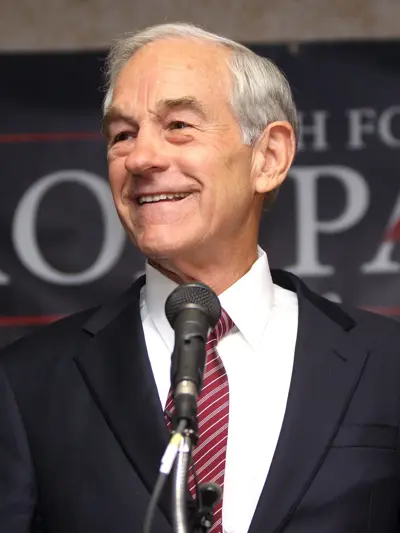
Ronald Ernest Paul is an American author, physician, and retired politician who served as the U.S. Representative for Texas's 22nd congressional district from 1976 to 1977 and again from 1979 to 1985, and for Texas's 14th congressional district from 1997 to 2013. On three occasions, he sought the presidency of the United States: as the Libertarian Party nominee in 1988 and as a candidate for the Republican Party in 2008 and 2012. A self-described constitutionalist, Paul is a critic of the federal government's fiscal policies, especially the existence of the Federal Reserve and the tax policy, as well as the military–industrial complex, the war on drugs, and the war on terror. He has also been a vocal critic of mass surveillance policies such as the USA PATRIOT Act and the NSA surveillance programs. He was the first chairman of the conservative PAC Citizens for a Sound Economy, a free-market group focused on limited government, and has been characterized as the "intellectual godfather" of the Tea Party movement, a fiscally conservative political movement that is largely against most matters of interventionism.
