Nouriel Roubini Quotes
I believe, unlike people that are totally free-market, laissez-faire fundamentalists, that there is an important role that the government can play - one, in providing public goods, whether it's education, health care, or other things, and two, supervising countercyclical policy - stimulus, whether it's monetary, fiscal, or otherwise.
Roubini, Nouriel, and Stephen Mihm. Crisis Economics: A Crash Course in the Future of Finance. Penguin Press, 2010, p. 195.


Islamic modernists like him are many among the educated Muslims but their views are often drowned out by the violence and extremist statements of the fundamentalists.


Devolution is the decentralization of government. Wales and Scotland were originally countries different from England. They came under the control of a single king but recently have obtained more autonomy—not unlike states in the United States. This reform was opposed by some politicians.


Spanish Colonial Policy and Practice was generally terrible and particularly so in the Philippines, See {629450}. So it was relatively easy for the President to document genuine improvements our imperialism had produced. However, the Filipinos would have preferred to make progress as an independent country.

This rigid view left no room for regulation which is what almost every modern industrial democracy has chosen. To some of his extremist followers, any government regulation of business or the economy whatsoever, regardless of how little, means that the nation has embraced socialism. It is in this sense that many extreme right wingers viewed Presidents like Franklin Delano Roosevelt, Harry Truman, John Kennedy, Bill Clinton, and Barack Obama as socialists while they saw themselves as opponents of socialism.
Mises observes the classic philosophical quandary of business and commerce. If we cannot leave everything to the market place and the capitalists and entrepreneurs because they are morally and ethically fallible, will not the government people who regulate and control them be equally moral and fallible? Mises critics point out that Mises misses the difference in a democracy, that if fallible businessmen err, all can suffer and their personal vested interests do not necessarily coincide with the interests of the majority in general. If the government representative of the majority are fallible and err, the majority can correct them and if the majority does not, the people have undone themselves and have not been the victims of the foibles of a few privileged people in the society. Mises argues that it is the minority who, if left alone, would produce the best standard of living for the majority who should exercise they right to regulation only by their acts as consumers.


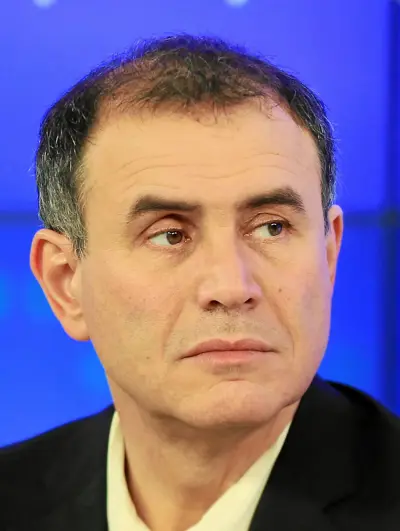
Nouriel Roubini is an American economist. He teaches at New York University's Stern School of Business and is chairman of Roubini Macro Associates LLC, an economic consultancy firm.
