E. Howard Hunt Quotes
I am not quibbling, but there's a difference between something that's illegal and something that's clandestine. An entry into something like Dr. Fielding's office would simply be called an entry operation conducted under the auspices of competent authority.
Hunt was in operational charge of the “Plumbers” and the illegal Watergate conspiracy, burglary and cover-up operations. He had denied participating in illegal activities, but admitted to “clandestine” activities which were against the law such as breaking into offices and stealing the contents. His “logic” was that if the President authorized something, it could not be against the law. The courts of course disagreed, and Hunt with most of the other Watergate Conspirators was convicted. Hunt’s argument was resurrected during the George W. Bush administration, when the Vice President and a few Bush appointed lawyers in the government took the position that torture of criminal suspects or wartime adversaries which was against the law, could be legally used if the President authorized it. They pointed out that Abraham Lincoln acted without authority of law on several occasions in the crises of the Civil War. However, Lincoln in all cases, went to Congress to obtain the authorization. The Bush people were surreptitious about their law breaking and publicly insisted that the did NOT brak the law, If it were not for leaks to the press, it would not have been known that the administration was breaking the law.
E. Howard Hunt, 1916-2007, White House Assistant (Republican), CIA Agent, Manager of the Nixon “Plumbers”, Grand Jury Testimony, Washington on May 2, 1973
Sourced by: Eigen's Political and Historical Quotations

The United States is the only nation that overtly defines covert activity in its legal system. It makes these very subtle distinctions which seemed to many intelligence leaders like Lowenthal a distinction without much of a difference and an attempt by our democracy to make moral and legal distinctions so the dirty parts of the business of espionage seems consistent with an open democracy.


Nixon's suspected that Brookings had evidence about the secret Cambodian bombings and his pre-election felony regarding Vietnam. White House Staff Member Tom Huston had put together a plan to obtain embarrassing and potentially ruinous documents and other documents that would allow them to blackmail Nixon's critics who were regarded as "enemies".

This quotation comes as a major surprise to most people who perceive modern CIA as the MAJOR U.S. spying and covert action organization. It is a marvelous case study of agency “mission creep”.

In an interesting "precursor" to Watergate, Houston recommended that President Nixon lift restrictions on "black bag" jobs against foreign embassies and suspected domestic "subversives."


Magruder and his boss OSS Director Donovan did not believe that the military services, the State Department nor the FBI could or should properly be breaking the laws of foreign nations which would be virtually certain if one was spying in foreign nations. They advocated the formal extension of a the wartime OSS which became the CIA. Magruder convinced Secretary Lovett and this was important in establishing a CIA successor to the OSS.

Casey continuously violated the law and lied to the President and Congress.


Intelligence agents tend to prefer covert activities to the less dramatic, non-exciting, activity of gathering and analyzing intelligence. Most national intelligence services tend to enlarge their portfolio to include covert activities regardless of what the national leaders intended. Because of the secrecy, they can often get away with this.
There was a military coup in 1973 which was supported by the United States -- {640618} . Many Chilean left wingers were tortured, murdered or disappeared. Also, two American citizens in Chile were murdered at the time. This case finally brought the murderers of the Americans from the military junta to account. However, it turned out that the murders of the Americans was part of a conspiracy between the Chilean junta and United States military / intelligence officers in Santiago at the time. The American murder victims were fingered by an American Naval Captain, Ray E. Davis, as leftists and they too were killed. Captain Davis had been indicted with the two Chileans, but he died before the trial. The Chilean judge was not able to indicate how high up the decision by the American officers to have the Chileans kill leftist Americans went. One important historical aspect of this case was meaningful because when the trial was finally conducted, there was a major policy debate in the United States over the right of the American government to kill American citizens abroad and under what circumstances with most people thinking that this was a new policy issue brought about by the development of drone technology and the War on Terror. However, this judge’s release of the information showed that Americans had been previously killed before drones. One major difference is that in the War on Terror case the President, Attorney General and other officials were the major decision makers while in the 1973 case in Chile, it may have been limited to a few rabid, over-zealous, mid-level officers, acting on their own. Or perhaps the kill decision went further. The documents relating to the murders are highly classified and the government has not yet released them at the time of this quotation.


This was meant as a criticism of Webster, but must people saw it as a compliment. What Clarridge and other old hands at the CIA could never get straight was that they were supposed to break the other countries’ laws but not the laws of the United States. They were supposed to lie to other countries, but not to our President and Congress. This has been a constant problem for United States intelligence agencies. Some scholars of espionage believe that a good spy or spy master lies so often that it is part of his nature to do so as well as break laws. Psychologically it is difficult for them not to lie to anyone and they have little respect for laws. Webster fired Clarridge when Webster reformed the CIA but in the process he alienated most of the “veterans”.


Dulles was writing about the World War II Abwehr, the German intelligence service.
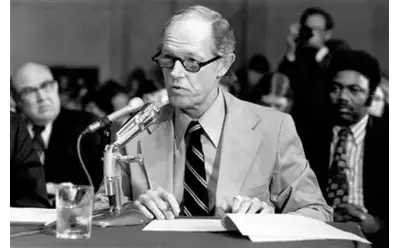
Everette Howard Hunt Jr. was an American intelligence officer and author. From 1949 to 1970, Hunt served as an officer in the Central Intelligence Agency (CIA), particularly in the United States involvement in regime change in Latin America including the 1954 Guatemalan coup d'état and the 1961 Bay of Pigs invasion. Along with G. Gordon Liddy, Frank Sturgis, and others, Hunt was one of the Nixon administration "plumbers", a team of operatives charged with identifying government sources of national security information "leaks" to outside parties. Hunt and Liddy plotted the Watergate burglaries and other clandestine operations for the Nixon administration. In the ensuing Watergate scandal, Hunt was convicted of burglary, conspiracy, and wiretapping, eventually serving 33 months in prison. After release, Hunt lived in Mexico and then Florida until his death.
