Edward I. Edwards Quotes
I am a wringing wet.
In the 1920's candidates generally took a stand on the issue of prohibition. He himself was a teetotaler.
Edward I. Edwards, 1863-1931, Governor of New Jersey (Democrat), Quoted in Reinhard H. Luthin, American Demagogues, Peter Smith, 1959
Sourced by: Eigen's Political and Historical Quotations


Selling alcohol and running saloons were against the law then in Kansas but there was no effort to enforce it anywhere in Kansas. Carrie Nation went into saloons and literally smashed the classes, signs, mirrors and furniture with an ax.

Selling alcohol and running saloons were against the law then in Kansas but there was no effort to enforce it anywhere in Kansas. Carrie Nation went into saloons and literally smashed the glasses, signs, mirrors and furniture with an ax. She smashed up the largest and most elegant saloon in Kansas and as jailed for it. She told the authorities this quotation and because of the publicity her jailing had caused, when she emerged an entire statewide and area movement had begun with Carrie as the leader.

Douglass had written of how the slave owners used alcohol to maintain control over the slaves: {611086}.

With Prohibition, the demand for alcohol was the same as ever, but the supply was restricted. Since much of the alcohol in the south was produced in illegal stills, Prohibition, did not affect the supply from those sources. As a matter of fact history shows that they ramped up production to fill the supply gap that was created by Prohibition. The North had very few illegal stills before Prohibition and there was very little capability to replace the legal sources that Prohibition had curtailed.

The poem was his summary of the Wickersham Commission’s (National Commission on Law Observance and Enforcement) conclusion regarding Prohibition.


The authenticity of this quotation has been in contention for years. While many sources attributed this statement to Lincoln, no one has ever found a document in which it appears. Further, it was so clearly consonant with the anti-Prohibition argument that we suspected it as a “Phantom Quotation” (See http://politicalquotes.org/node/4063). As a result, we did not include this quotation until March of 2014. The reason we changed our mind was a newspaper article that was pointed out to us, and after reading it, we tilted in favor of inclusion. The article is http://druglibrary.org/schaffer/LincolnQuote/lpq0001.jpg

President Barack Obama had the week before, made a speech observing the fact that marijuana was less dangerous then alcohol.


He was also a paid lobbyist for the beer industry.
The DEA is the Drug Enforcement Administration.


This is a wonderful historical quotation which illustrates the effect of Prohibition on Norway—most of which was negative. Despite the fact that this article had been published in a leading American journal, virtually no one paid attention to it when Prohibition was being debated and instituted in America a few years later. Another aspect of the quotation is the economic effect. It illustrates how easy it is to start a trade war that was completely unintended. Also how a country, in this case Portugal and Spain, will make foreign policy decisions of which their poorer people bear the brunt.
As this historical quotation shows, globalization was well developed even in 1925. It did not appear suddenly.


Most people only know about Garrison’s abolition crusade. However he had others like temperance.

Father of Harriet Beecher Stowe and Henry Ward Beecher. Father of Harriet Beecher Stowe and Henry Ward Beecher

British merchants and the East India Company made huge profits from the drug trade buying opium in India and selling it to China where it had become immensely popular. But when the Chinese (led by Lin Zexu) tried to ban the import of opium, the British fought two wars with China to force the reopening of the opium trade. At the end of the 20th century, some referred to England and the English Crown as the largest Drug Cartel in history.
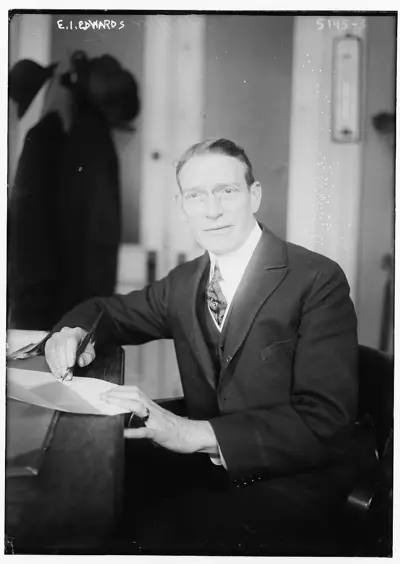
Edward Irving Edwards was an American Democratic Party politician who served as the 37th Governor of New Jersey from 1920 to 1923 and in the United States Senate from 1923 to 1929.
