Alexandre Dumas Quotes
I am a count, not a saint.


John Adams was more concerned about the titles and forms of address of the President and Vice President than most of the Founding Fathers. Having spent time in London and Paris representing the nation, he was concerned about the dignity and symbolism of office. McCullough added this insight.

Maria, after being ousted by her former friend, General Baldomero Espartero, comments on his lack of respect.

Here we have a very mockery of the concept of aristocracy and “good family”. This humorous essay was written less than a decade after Darwin published his first treatise on evolution. Here a witty American essayist and critic is giving an insight into the thoughts of the many people who either were scandalized by the concept of human evolution or honestly could not grasp such a new intellectual set of concepts. Many of the great scientific intellectual breakthroughs spread with stunning rapidly—usually amongst scientists, but in the case of evolution to most intellectuals and men of letters, they could use Darwin’s framework and observe evidence of evolution all over. So here, less than 10 years from the inception of evolutionary theory among English scientist, we have American non-scientific literati reading articles in the general (albeit sophisticated) Atlantic Monthly with a semi-serious, semi-comical, analysis of the thinking of people who resisted what had become in just a few years obvious truth to America’s leading intellectuals (except for most of the leading intellectual theologians who would take longer to accept evolution, but, with the exception of the extreme fundamentalists, most did.
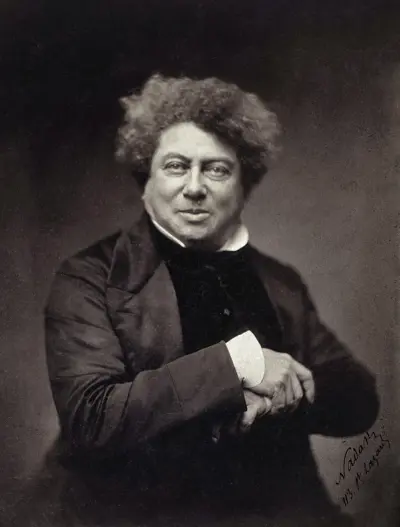
Alexandre Dumas, also known as Alexandre Dumas père (where père is French for 'father', thus 'the elder/senior'), was a French writer. His works have been translated into many languages, and he is one of the most widely read French authors. Many of his historical novels of high adventure were originally published as serials, including The Count of Monte Cristo, The Three Musketeers, Twenty Years After, and The Vicomte of Bragelonne: Ten Years Later. His novels have been adapted since the early twentieth century into nearly 200 films.
