Albert Einstein Quotes
How much do I love that noble man More than I could tell with words I fear though he'll remain alone With a holy halo of his own.
Einstein wrote this famous poem in honor of Baruch Spinioza, the 16th Century Dutch Philosopher who has had the most influence on modern scientific thinking. Einstein was not only influenced scientifically, but as a religious man his personal theology was most influenced by Spinioza. See related quotes.
Albert Einstein, Poem, "Zu Spinozas Ethik", 1920
Sourced by: Eigen's Political and Historical Quotations

Einstein’s religious views were very sophisticated and unusual. He was a deist—a believer in God. He was of Jewish background and like some Protestant sects, Jews can interpret scripture and the nature of God as individuals. They need not follow a particular doctrine. However Einstein had a very complex vision of God—as he described it, the “God of Spinoza”—a 17th century Rabbi and Philosopher whose views were so radical that his books were banned and he was excommunicated by the Rabbis of Holland, a rarity in Judaism. This view of God is not the human-related form but a view of God as an abstraction everpresent and a prime mover inherent in nature, the world and in humanity.

The first clause of the quotation was itself a quotation that was originated by the eminent British Jurist, Historian and academic--Sir Frederick Pollock. Spinoza has been as influential on intellectuals and their works as any other and is up there with Aristotle and Plato, However, while through his influence, the average person is familiar with many of his ideas, his writing is so abstract that few people can understand it with out a great intellectual effort. Baruch Spinoza has influenced thought on many areas but science, in particular, has benefited from his analyses and ideas. See Einstein's Quotation 644230.


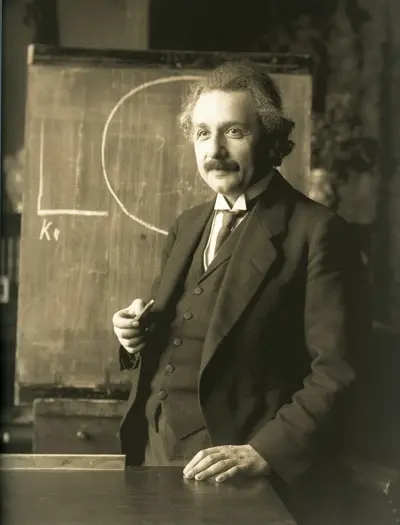
Albert Einstein was a German-born theoretical physicist, widely acknowledged to be one of the greatest physicists of all time. Einstein is known for developing the theory of relativity, but he also made important contributions to the development of the theory of quantum mechanics. Relativity and quantum mechanics are together the two pillars of modern physics. His mass–energy equivalence formula E = mc2, which arises from relativity theory, has been dubbed "the world's most famous equation". His work is also known for its influence on the philosophy of science. He received the 1921 Nobel Prize in Physics "for his services to theoretical physics, and especially for his discovery of the law of the photoelectric effect", a pivotal step in the development of quantum theory. His intellectual achievements and originality resulted in "Einstein" becoming synonymous with "genius".
