Neville Chamberlain Quotes
How horrible, fantastic, incredible it is that we should be digging trenches and trying on gas masks here because of a quarrel in a far away country between people of whom we know nothing.
Neville Chamberlain, 1869-1940, British Prime Minister, Commenting on the pre World War II conflict in Europe when Germany invaded the Sudetenland, Radio Address, September 27, 1938
Sourced by: Eigen's Political and Historical Quotations


1st Viscount Grey of Fallodon. The first published version of this prescient quotation appeared.


Germany had just attacked Russia with whom it had a treaty. For a while, Hitler paid little attention to Italy and just gave their “ally” orders and instructions. Italian public opinion was concerned about the same question. See {627973} .


1914 was the outbreak of WWI in which all the belligerents had very different interests and reasons for war—even allies on the same side greatly differed as to their motivation for fighting.

See the American ambassador’s assessment after the war began {41089}


A little over a decade later the struggle began.


In 1918 the Treaty of Versailles—peace treaty ending WWI—was signed. Many Germans felt that their defeat in WWI forced them to sign the treaty which weakened Germany and assured that they would be a 2nd rate power thereafter. After that Germans blamed every negative aspect of their government, economy and society on the treaty that was “forced” on them. Nazism was a consequence of these feelings, and the Nazis adopted policies and practices to get around their anti-military obligations and have a strong government so that the allies could not enforce the treaty obligations on Germany.

stating that war was obsolete See {640087} for the quotation of exactly what Angell wrote.

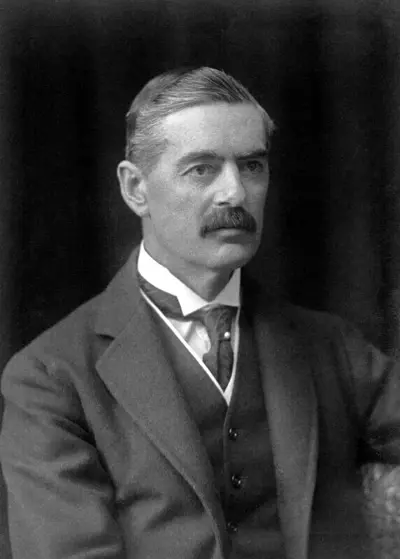
Arthur Neville Chamberlain FRS was Prime Minister of the United Kingdom and Leader of the Conservative Party from 1937 to 1940. He is best known for his foreign policy of appeasement, and in particular for his signing of the Munich Agreement on 30 September 1938, conceding the German-speaking Sudetenland region of Czechoslovakia to Germany. Following the German invasion of Poland on 1 September 1939, which marked the beginning of World War II, Chamberlain announced the declaration of war on Germany two days later and led the United Kingdom through the first eight months of the war until his resignation as prime minister on 10 May 1940.
