Ernest Hemingway Quotes
How did we go bankrupt? Two ways. Slowly, and then all of a sudden.
Hemingway, Ernest. The Sun Also Rises. Charles Scribner's Sons, 1926.


by stopping all interest payments on Federal Debts. because Jefferson would dismantle the Navy. Hamilton, a Federalist was supporting John Adams for a second term, and created lies that made the 2012 Republican prevarications against Barack Obama seem like innocent fibs. These 3 lies covered the areas which candidates ever since have gotten mileage out of attacking the opposition. 1) He is fiscally irresponsible and would ruin the economy. 2) He does not support the Constitution. 3) He is unpatriotic and would weaken the military. These have been the 3 favorite areas for lying about an opponent ever since. As in {629237} each of the lies has a grain of truth in it to make it more believable. Jefferson had been an opponent of the Federal Government assuming the States’ Revolutionary War debts, but he never favored defaulting on the interest after the debt was assumed and when elected always paid the interest. Jefferson was representing the United States in France when the Constitutional Convention was held and was not a part of its creation. He was critical of parts of the Constitution and was one of the many who demanded that a Bill of Rights be added. Therefore Hamilton claimed he was against the Constitution. Jefferson was opposed to a standing professional army. It turned out that when he was President. he not only built up the Navy but used it to attack the Barbary States who were assaulting our ships. These were just the biggest lies; the Federalists had many more, and Hamilton enumerated several in this article.


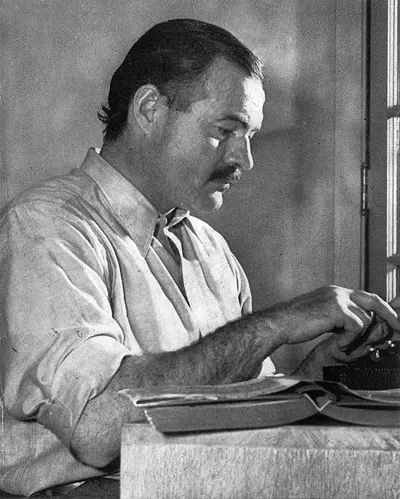
Ernest Miller Hemingway was an American novelist, short-story writer, journalist, and sportsman. His economical and understated style—which he termed the iceberg theory—had a strong influence on 20th-century fiction, while his adventurous lifestyle and his public image brought him admiration from later generations. Hemingway produced most of his work between the mid-1920s and the mid-1950s, and he was awarded the Nobel Prize in Literature in 1954. He published seven novels, six short-story collections, and two nonfiction works. Three of his novels, four short-story collections, and three nonfiction works were published posthumously. Many of his works are considered classics of American literature.
