Albert Einstein Quotes
Hitler is living on the empty stomach of Germany …. Better political insight has a hard time winning as long as there is little prospect of filling the stomach.
Germany was in a catastrophic depression with hyper inflation at the same time. Einstein was one of the few world leaders who realized that as long as Germans had not enough to eat, they were easy prey for demagogues like Hitler and philosophies like Nazism and Fascism.
Albert Einstein, 1879-1955, Nobel laureate in Physics, In Cosmic Religion, 1931
Sourced by: Eigen's Political and Historical Quotations


She, like her husband and many of the America Firsters, believed that Hitler should be allowed to overrun Europe and Russia. See {613688}. The America First group was a pro-fascist organization who supported the axis powers until they declared war on the United States. Even then, there were some Nazi sympathizers who were anti-immigrant, racist and anti-Semitic in addition to being fascists. Both of the Lindberghs were America Firsters


Frau Wagner was one of several agents of Nazi Germany sent to the United States to develop good will for Germany and funds for Hitler. Anti-German feeling was still high from the First World War but America had its share of right wingers like Ford. Hitler and Ford were mutual admirers. See {586988} for Hitler’s view of Ford.


He defeated Adolf Hitler at the polls in 1932, but the next year he was compelled to yield to Nazi power and appointed Hitler Chancellor of Germany.

Hoovervilles were camps of people who lived in city parks or empty land. Tar paper shacks sheltered some—others lived in boxes. People had no work and no prospects of work; they had no money for rent; they just lived a meager existence as best they could under conditions that today exist only in the third world. They were named Hoovervilles for the President at the time whose ineptness and philosophy simply let things deteriorate. Republicans were critical of many of Roosevelt’s economic policies, but the president would periodically remind them and the nation of what the situation was when the Republicans last ran the country.

This quotation is important because there are some who believed that the professional German Soldiers did not respect Hitler and his murderous policies. This quotation shows that at least publicly Donitz had no problem extolling Hitler above all others. After the war Donitz was found guilty of Unrestricted Submarine Warfare and using thousands of slave laborers in his shipyards. He was sentenced to 10 years, one of the lightest sentences if the German War Crimes Trials.

The historical record that is available shows that while the Pope did not, actively or aggressively oppose Hitler, and he did not discipline Catholic prelates who were Nazi supporters, there is no specific evidence that shows the Pope conspired with Hitler, about the extermination of Jews or anything else. However, most of the relevant documents of the era are in the Vatican and the records have been sealed and have not been visible to historians. Apologists for the Pope’s passivity point out that a large percentage of Germans were Catholic and he had a duty to not antagonize Hitler who would retaliate against German Catholics and the German Catholic clergy and church property. Further, Fascist Italy was under Hitler’s control, and the Vatican itself could have closed and its property seized. The historical record is still very vague.


It is amazing what explanations religious and biased fanatics can come up with to explain history.

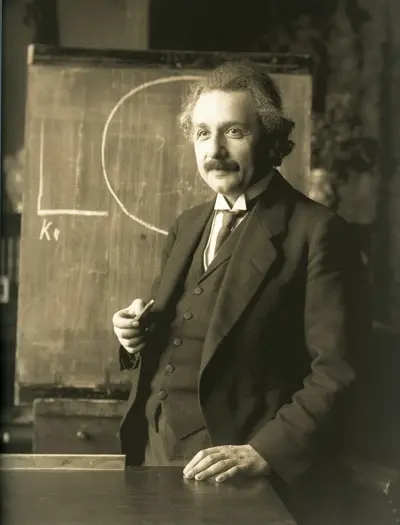
Albert Einstein was a German-born theoretical physicist, widely acknowledged to be one of the greatest physicists of all time. Einstein is known for developing the theory of relativity, but he also made important contributions to the development of the theory of quantum mechanics. Relativity and quantum mechanics are together the two pillars of modern physics. His mass–energy equivalence formula E = mc2, which arises from relativity theory, has been dubbed "the world's most famous equation". His work is also known for its influence on the philosophy of science. He received the 1921 Nobel Prize in Physics "for his services to theoretical physics, and especially for his discovery of the law of the photoelectric effect", a pivotal step in the development of quantum theory. His intellectual achievements and originality resulted in "Einstein" becoming synonymous with "genius".
