Fulton J. Sheen Quotes
Hearing nuns' confessions is like being stoned to death with popcorn.
Reeves, Thomas C. America's Bishop: The Life and Times of Fulton J. Sheen. Encounter Books, 2001, p. 280.


They killed him immediately after. The Cardinal had overthrown Scottish liberties, and tortured and murdered Protestants. Three months earlier, he had burned at the stake George Wishart, a very popular Reformer. In the history of religious persecution between Protestants and Catholics each group wreaked vengeance on innocent members of the other group while the murderers generally remained safe in their positions of power. In this case however, friends of Wishart broke into the Cardinal’s castle and executed Beacon. They hanged his naked body by one ankle out of the window, facing the place where George Wishart had been murdered.

This was a fairly radical constraint on what had been a traditional priestly prerogative throughout the ages. However, the penalty for such a sin and infraction was rather modest—a warning for the first offence, followed by reducing the cleric’s income. There were more serious punishments proscribed for repeated offenses, but typical of most reform efforts a newly prohibited activity carries a very light penalty. For example $20 fines for providing alcohol to a minor was the initial penalty in some states. A then current comparison can be made since elsewhere in this council dueling between Christians was also prohibited. But the penalty for even the first offence was excommunication.


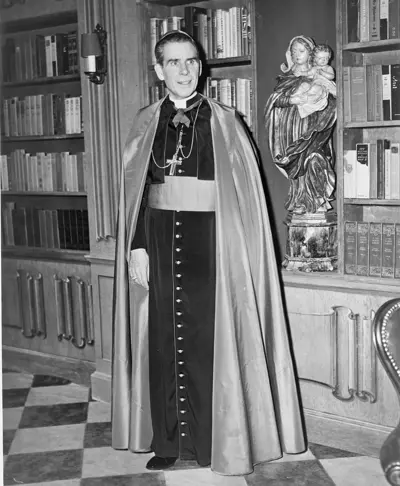
Fulton John Sheen was an American bishop (later archbishop) of the Catholic Church known for his preaching and especially his work on television and radio. Ordained a priest of the Diocese of Peoria in 1919, Sheen quickly became a renowned theologian, earning the Cardinal Mercier Prize for International Philosophy in 1923. He went on to teach theology and philosophy at the Catholic University of America as well as acting as a parish priest before being appointed Auxiliary Bishop of the Archdiocese of New York in 1951. He held this position until 1966 when he was made the Bishop of Rochester. He resigned in 1969 as his 75th birthday approached, and was made the Archbishop of the titular see of Newport, Wales.
