Friedrich Nietzsche Quotes
Great men's errors are to be venerated as more fruitful than little men's truths.
Nietzsche, Friedrich. Human, All Too Human. Translated by R. J. Hollingdale, Cambridge University Press, 1996.


This quotation shows FDR doing something that politicians rarely do. The country was in the midst of the Great Depression and he was running for the Presidency against Herbert Hoover who as President would do little to help the destitute part of the population or improve the economy. Roosevelt did not lay out specific programs which he claimed would fix the problem. He himself really didn’t know for certain what would and what would not. However he promised bold experimentation—trying new things. When he was elected, he was able to fail with one program and just shift to another until enough were successful. But the great contrast was to Hoover who would do little.
Two of the 20th centuries greatest political leaders were Mao Tse-Tung and Franklin Delano Roosevelt. In most respects, these two were polar opposites. However, they had one characteristic in common. They were both willing to try things they were not certain of. If they succeeded, make it a part of the national program. If it failed, try something else. See Mao {642795}.


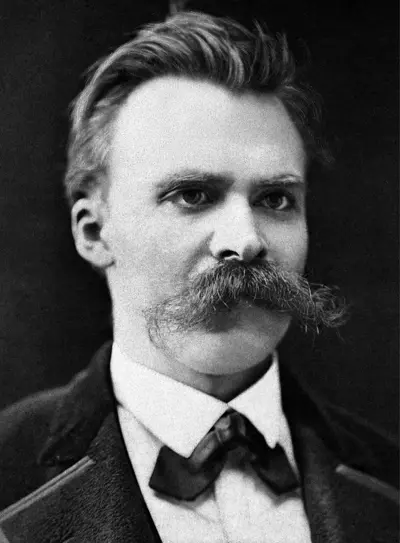
Friedrich Wilhelm Nietzsche was a German philosopher, cultural critic, composer, poet, writer, and philologist whose work has exerted a profound influence on modern intellectual history. He began his career as a classical philologist before turning to philosophy. He became the youngest person ever to hold the Chair of Classical Philology at the University of Basel in 1869 at the age of 24. Nietzsche resigned in 1879 due to health problems that plagued him most of his life; he completed much of his core writing in the following decade. In 1889, at age 44, he suffered a collapse and afterward a complete loss of his mental faculties. He lived his remaining years in the care of his mother until her death in 1897 and then with his sister Elisabeth Förster-Nietzsche. Nietzsche died in 1900.
