Thomas Friedman Quotes
Golf has an ambivalent relationship with the environment. On one hand, it's a great preserver of open spaces. Golf doesn't pave the world - it helps to green the world. But the downside is, it uses a lot of fertilizer, pesticides and water.
Friedman, Thomas L. Hot, Flat, and Crowded: Why We Need a Green Revolution--and How It Can Renew America. Farrar, Straus and Giroux, 2008.


His studies showed that at the end of the 10th Century, London was booming. At that time the diet changed rapidly from fresh water fish to salt water fish. The economic boom and growth placed heavy demand on the fresh water fish stock which had become depleted. Londoners then turned to the ocean for their fish. Now the oceans are becoming depleted of fish stocks, and the next step is likely to be large scale fish farming.

The Rio Grande River flows through New Mexico on its way to Texas. However, for many reasons the river flow is diminishing and only a little water makes it to Texas. Some Texas politicians wanted the New Mexican farmers, who were miles from the river and have paid to drill wells which they use to pump water for their irrigation, to limit their water pumping. They argued that the pumping was diminishing the water in the underground aquifer, and this was causing some of the water flowing down the river to flow into the New Mexico aquifer thereby diminishing the river flow. The New Mexican farmers argue that they paid a great deal for that land because it came with water rights under the ground and the water is theirs. This was one of the many intractable problems of agricultural water allocation in the West where farmers plant many crops that would not normally survive in that part of the country without artificial irrigation.
Coca Cola is mostly water with sugar and a little syrup for flavoring. In addition, water is used heavily in the manufacturing processes of bottles and cans.


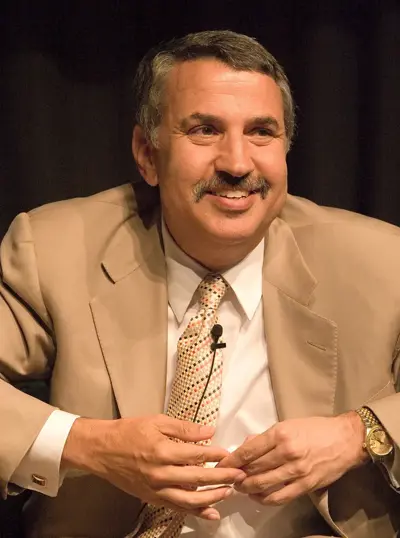
Thomas Loren Friedman is an American political commentator and author. He is a three-time Pulitzer Prize winner who is a weekly columnist for The New York Times. He has written extensively on foreign affairs, global trade, the Middle East, globalization, and environmental issues.
