Michael Hayden Quotes
George Tenet was actually a very strong centralizing force. If you met George by personality, George met with the president six days out of seven: nontrivial attribute inside the federal government. And George was head of the CIA.
Hayden, Michael V. Playing to the Edge: American Intelligence in the Age of Terror. Penguin Press, 2016.


The CIA has never denied this, and it seems to be corroborated in that none of the CIA reports to the Presidents ever mentioned the failures and there is no CIA official who ever claimed that they informed either of the Presidents. In particular, when Kennedy initially went along with the ill-fated CIA Bay of Pigs invasion plan not realizing that the CIA had a dismal record of major misjudgments and failures of covert operations.

Actually, this is true for most government agencies and many non-government institutions as well. The concern is greater when organizations whose policies can affect life and death are not consciously developing and choosing policy alternatives and yet the policies are made by default.

even though in this case the objective The State Department, the Defense Department and most important President Kennedy had decided to get rid of Diem. Most of the Central Intelligence Agency thought that this was a very unwise policy, because Diem was a known risk, and the people who would replace him and their talents and policies were unknown. The negatives of Diem—the facts that he, a Christian, was persecuting the majority Buddhists, was totally corrupt, and not a very good leader was less distressful to the CIA than to the President and the other agencies as the intelligence agency frequently not only tolerated “offensive” allies, but actually employed them including war criminals. Another importance of this quotation is that it shows that it was by no means certain that the CIA would always follow the orders of the President and the government policy makers. Colby, who was not the agency director at that time but was the head of the South East Bureau, was one high level official who argued that the policies should always be followed even if they were unwise or foolish. Another importance of this quotation is that it illustrate a common error that administrations are frequently forced to make: making a policy decision to eliminate a problem while not having much of an idea of what the alternative or consequence would be when the policy is implemented. The Syrian Civil War in 2013 was a good example. The Government side appeared to have used Chemical Warfare on Civilians and public opinion demanded that we do something. However, having a no-fly zone or any of the alternatives to prevent (punish) the government for the Chemical Warfare would strengthen the rebel side which was made up of numerous factions—some of which were known Islamic fundamentalist terrorists and jihadists. If the balance of power were tipped toward the rebels, the consequence for the American national interests were unknown—just as the consequence of ousting Diem was unknown and turned out to also be bad and was probably worse.

John Foster Dulles was the Secretary of State and brother Allen Dulles was head of the CIA.


The WWI veterans lobby was formed and they pressured Congress into authorizing a bonus of between $1 and $1.25 for each day of wartime service. However, the catch was that they would not be paid until 1945 unless they did, Hence the name for the bonus. The Bonus March on Washington would eventually march on Washington to get their pay while they were still alive. Finally, the bonuses were paid immediately after Franklin Delano Roosevelt assumed the Presidency even though he personally opposed paying it early. Congress passed the law over his veto.

Harry S Truman
Explaining why speakers from Washington are more in demand than those from other cities:


Explaining his resignation as CIA Director


In her younger days Steinham worked with the CIA. Originally the Office of Strategic Service, the precursor to the CIA, was an amalgam of some of the nation’s most educated and dedicated people who tended to be very idealistic in saving the world from fascists like Nazi Germany and Japan. The were extremely nonpolitical and were not involved in the liberal conservative battles that the agency got itself into as the Red Scare and the fear of Communism affected much of the society including the CIA.
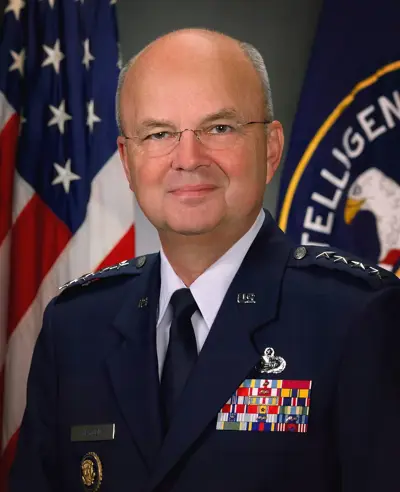
Michael Vincent Hayden is a retired United States Air Force four-star general and former Director of the National Security Agency, Principal Deputy Director of National Intelligence, and Director of the Central Intelligence Agency. Hayden currently co-chairs the Bipartisan Policy Center's Electric Grid Cyber Security Initiative. In 2017, Hayden became a national security analyst for CNN.
