Pericles Quotes
Freedom is the sure possession of those alone who have the courage to defend it.


In one of the most unusual revolutions in world history, Brazil became independent from Portugal via a revolution led by the son of the Portuguese King and heir to the throne, Pedro I. The crown prince of Portugal, led Brazil in her breakaway from Portugal and by popular acclaim became Pedro I, Emperor of Brazil. He is probably the only monarch in history who was the heredity monarch of one kingdom and selected by popular acclaim to the throne of another.

The free man, not controlled by others may see no rational reason to fight and therefore the refusal to war can be as courageous as fighting. This idea is still not accepted in many cultures and nations. The issue was argued mightily in the Vietnam War. Spinoza’s ideas were considered so radical and dangerous that he was the only man in history who was excommunicated by the Catholics, the Jews and the Muslims.

This was the intellectual basis of the famous speech by Barry Goldwater in the 1964 presidential race—see related quote.
For a similar Ancient Greek version of this notion, See : {632265}.

This passage from Mormon scripture justifies self defense and certain righteous war. It is also used by some Christians to argue that Mormons are not Christians because they do not accept Christ’s directive to “turn the other cheek”.


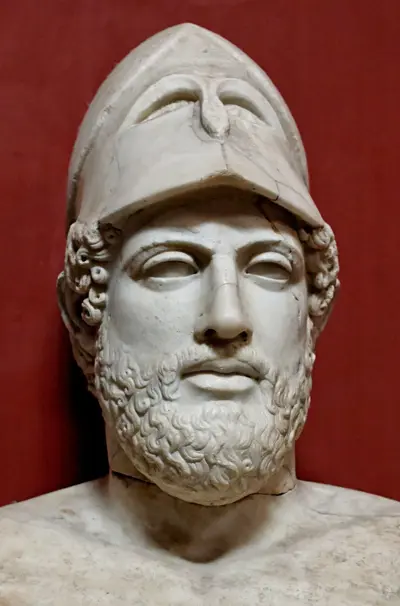
Pericles (/ˈpɛrɪkliːz/; Attic Greek: Περικλῆς, pronounced [pe.ri.klɛ̂ːs] in Classical Attic; c. 495 – 429 BC) was a Greek statesman and general of Athens during its golden age. Pericles was prominent and influential in Athenian politics, particularly between the Persian and the Peloponnesian Wars, and was acclaimed by Thucydides, a contemporary historian, as "the first citizen of Athens". He turned the Delian League into an Athenian empire and led his countrymen during the first two years of the Peloponnesian War. The period during which he led Athens, roughly from 461 to 429 BC, is sometimes known as the "Age of Pericles", but the period thus denoted can include times as early as the Persian Wars or as late as the following century.
