Mahershala Ali Quotes
'Free State of Jones' went beyond that. It got into how the South wasn't as homogenous as we thought it was - or even the North for that matter, where we like to assume everyone wanted to free the slaves and they were all abolitionists. It actually shows how complex these ideologies were on both sides.
Ali, Mahershala. Interview by Christina Radish. Collider, 23 June 2016.

As just one example of Southern States' reasons, see {583044}. Many of the Northern States had passed laws declaring everyone in the state was free and making it illegal to return or assist in the returning of escaped slaves. The Southerners got the Federal Fugitive Slave Act passed which required all Americans to assist in recapturing escaped slaves. It was the Northern States who claimed states' rights were being trampled. The South was vehemently opposed to States' Rights when it came to allowing individual states to decide who was free and who was not. The Southerners had only one fundamental reason for secession—the maintenance of the Negro slavery system on which much of their economy depended as did their sociology, culture, and way of life.

When the first Southern States seceded, each appointed a whose job it was to persuade the other Southern States to also secede. In this case Hale was marketing secession to Kentucky which with Maryland were the only two Southern States to reject what they regarded as treason and rebellion. The importance of the quotation however is in his argument which was all based on enmity to racial equality and abolition. Later Southern apologists would argue that the Civil War was fought, not about slavery and racism butt about different philosophies of government. See {623715} .
Gusley had been captured by the Confederates and was in a prison camp. Richardson published Gusley’s diary and Southerners were surprised to find that this Yankee who had been bombarding them from a ship was very similar to them in many ways including slavery but saw the situation regarding succession as worth fighting for preservation of the Union.
The last lines of the editorial were tragically accurate in predicting the Civil War. The more the slavery question was debated in the nation, the more polarized the country became. If the South would persist in trying to curtail men’s freedom and maintain slavery, the slaves had the same right of revolution and insurrection as was established in the American Revolution. That was the view of most abolitionists. Southern slave holders, feared an armed slave rebellion more than anything else, and observed that debating the issue of slavery was just riling up Blacks and whites and would instigate such armed revolutions. The Southern solution was to cease debating the slavery question. The Northern solution was to end slavery. Neither side would accept the solution of the other and the Civil War ensued.


Buchanan us considered by most historians to have been the worst or one of the worst Presidents of the United States. At this point, he was a lame duck president with Abraham Lincoln, the President Elect soon to take office. This speech, just encouraged the South more than ever and helped to bring about the Civil War. His vacillation and lack of any leadership on the slavery question exacerbated the polarization that was tearing the nation apart.
See Mark {606304}; also Matthew {606727}. Lincoln had used the “house divided” biblical metaphor in 1843 when arguing for Whig solidarity. The first political use of the Biblical metaphor and quotation with respect to American slavery appears to have been by Sam Houston in 1850 {603970}. The first use with respect to American slavery was byMassachusetts abolitionist, Edmund Quincy, in 1852. The second sentence of this famous quotation was forsaged earlier. See Lincoln, {619494} & {584918}. Also See Felix Rohatyn who used the Lincoln line to refer to poverty: {70611}.


The early Union military leadership was so poor and timid that it was not clearly demonstrated that a Confederacy was not viable until later in the war, and the Southerners possessed an extraordinary capacity for ignoring reality and self-delusion, that it was not demonstrated until Grant’s major victories and Sherman’s March through Georgia and the Southern East Coast that an independent South was not going to be.

Ingersoll was considered to be the greatest orator and political thinker of his day, but his overt atheistic views curtailed his elected political career.


In many respects, it is amazing that secession did not take place earlier.

The reason for secession was the threat to slavery, which was a great threat to the slave-owners of the South. However, the non slave-owners had a very strong vested interest in maintaining slavery in that most Southerners had been brought up with such a negative view of Blacks that they were paranoid of Black equality or even worse some Blacks in positions of authority over whites. At the time, it was the Republican Party that was the advocate for minority equality and the Democratic Party embraced the racists. The parties would flip flop after the Civil Rights Act of 1964 ending legal segregation was passed by a Democratic President and a Democratic Majority Congress.


Essentially, the case of moral hazard was made against paying the slave owners. Lincoln took a pragmatic approach. However, not only was Northern opposition too strong for this proposal, but the Southern slave holders would never agree to selling their slaves. What Lincoln and most “pragmatic” Northerners did not realize is that even if the slave owners would get a fair market price for the slaves, they would be left with land and no way to work it. Their families would have no servants. They might have to work themselves like Northern farmers did, and their entire standard and style of living would be destroyed. Their sons were not well educated as many Northern young men were and were brought up to be gentlemen, politicians, and occasional soldiers—not work with their hands. They could not compete. And the slaveholders were right as the whole history of Reconstruction and backwardness demonstrated for more than 100 years.
This quotation is often given by those who argue that Lincoln really did not care about the slavery issue. It is a terrific example of the limitations of quotations where there is artful rhetoric. Douglas, had in the 1st debate posed 7 “interrogatories” to Lincoln asking if he were pledged to certain positions regarding slavery. Douglas was trying to associate Lincoln with the most radical abolitionists in the land. By asking if Lincoln were pledged to the positions, Douglas thought that he had cornered Lincoln. For if Lincoln denied the pledges, he would appear to be backing off his anti slavery positions, and if Lincoln would not, then he would appear to support the most radical elements. Lincoln turned the rhetorical tables on his opponent. He first answered the question literally, emphasizing “pledged”. Just as Douglas thought he had forced Lincoln off his anti-slavery views, Lincoln stated what he would “like to see” as opposed to what he was pledged for. See {615826}.
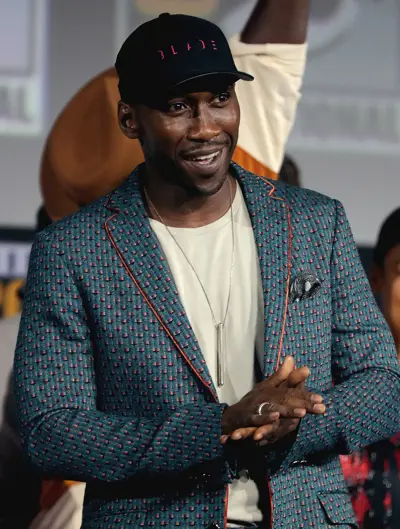
Mahershala Ali is an American actor and former rapper who is the recipient of several accolades, including two Academy Awards, three Screen Actors Guild Awards, a BAFTA award, a Golden Globe Award and a Primetime Emmy Award. Time magazine named him one of the 100 most influential people in the world in 2019. In 2020, The New York Times ranked him #23 in its list of the 25 Greatest Actors of the 21st Century.
