Frank B. Kellogg Quotes
France and Italy have not yet signed this treaty or agreed to naval limitation as between those nations, but I have confidence that in time they will do so.
Kellogg, Frank B. "The Renunciation of War." Nobel Lecture, 11 Dec. 1930, Norwegian Nobel Institute, Oslo. Nobel Lectures, Peace 1926-1950, edited by Frederick W. Haberman, Elsevier Publishing Company, 1972.


He was shot as a traitor when de Gaulle returned. See {587231} and {587230}.


This appears to be the first American expression of the balance of power doctrine in foreign policy.


2nd Viscount Melbourne. The “American treaty” was the Webster–Ashburton Treaty to adjust the final borders between Canada and the United States that were still in dispute from the War of 1812. Note that the British Prime Minister was critical of the position that was being taken be some British diplomats. In many American negotiations with Russia and others, there are hard liners who believe that the negotiators want too much to preserve peace and are not sufficiently willing to go to war for the nation’s principles and honor. As this quotation shows, this is not just an American phenomenon, but in almost all nations there are hard liners critical of all international negotiations and fearing that a desire for an agreement will undermine the positions that should be taken. This is an example where the hard liners were on the non American side.


The existing treaties of many of the different European countries like the NATO Treaty obliged them to assist their allies if they were involved in war. Once Austria attacked Serbia, Russia had to assist Serbia against Austria. Germany then joined with Austria and that triggered the treaty whereby France had to support Russia. And when Germany overran Belgium to attack France, England was obligated to come to Belgium’s defense. The only country that had planned for and wanted war was Germany who used her obligation to Austria as the excuse to implement her war plans (see {642092}). The entire Western World was at war when all but one nation wanted to avoid war. The communications and diplomacy of the time could not keep up with events and one of the worst wars in history ensued.
Like many in the 1920s, Dewar saw the Communist Soviet Union as the biggest potential risk to peace. However, although the Russian leaders constantly castigated the West, they did not have a large military, and were for the most part highly anti-war as they saw war as the product of Capitalistic competition and the tool of the aristocracy. They had little military equipment and almost no training or officer corps with which to build any Army. Germany in contrast had the skill, experience, officers, a history of aggression, and huge resentment over what they considered their humiliating WWI defeat and peace terms. They would start WWII, not Russia.


_0_thumbnail_47x47.jpg)


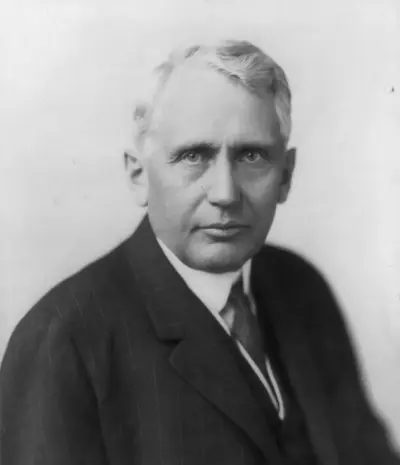
Frank Billings Kellogg was an American lawyer, politician, and statesman who served in the U.S. Senate and as U.S. Secretary of State. He co-authored the Kellogg–Briand Pact, for which he was awarded the Nobel Peace Prize in 1929.
