Herman Melville Quotes
Forty years after a battle it is easy for a non-combatant to reason about how it ought to have been fought. It is another thing personally and under fire to direct the fighting while involved in the obscuring smoke of it.
Melville, Herman. Billy Budd and Other Prose Pieces. Edited by Raymond W. Weaver, Constable & Company, 1924, p. 88.


Candidates are always being asked in the middle of campaigns what they will do if they are defeated.

The Emperor was writing to his son to explain the defeat of Japan. In what was a bit of revisionist history, the Emperor neglected to mention that with the exception of some of the incursions in China, Hirohito had personally approved every Japanese invasion including Pearl Harbor. Further, it was he who had approved the orders that Japanese troops should fight to the death rather than retreat or surrender.


The General refused. He had already achieved a strategic victory and it was only a matter of time when the Dutch would withdraw on their own as their supply lines were cut off and the populations wanted them out.

McClellan liked to parade and drill his troops but not fight them. Lincoln wanted him to take the offensive but the general always found an excuse not to. Many historians believe that McClellan wanted the war to end, the South to rejoin the Union and be allowed to maintain slavery. Others feel that he was just a military man who maintained his popularity by minimizing casualties. Finally, Lincoln fired McLellan and the complexion of the war changed thereafter. McClellan ran against Lincoln for the Presidency in 1864. See {633923}

He was objecting to the current crop of senior military officer who have little experience in fighting and much in academic, strategic and technical training. Many however see him as a dinosaur who does not realized the complex nature of the modern military missions. In general, we have won almost all of our fighting battles but often failed in our maintaining civil society, occupation, nation building, military procurement, preventing sexual assault of our own troops by our own soldiers, assuring mental health of our soldiers. Hackworth, detractors argue, wants to change what already works and ignore what does not.


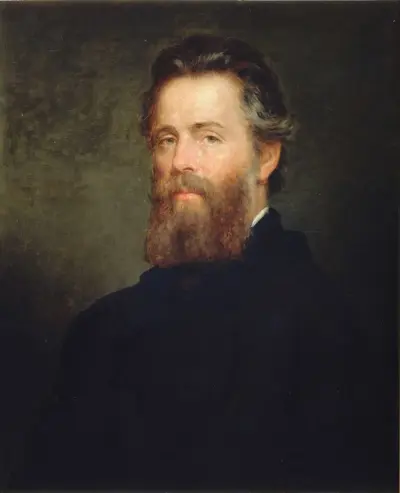
Herman Melville was an American novelist, short story writer, and poet of the American Renaissance period. Among his best-known works are Moby-Dick (1851), Typee (1846), a romanticized account of his experiences in Polynesia, and Billy Budd, Sailor, a posthumously published novella. Although his reputation was not high at the time of his death, the centennial of his birth in 1919 was the starting point of a Melville revival and Moby-Dick grew to be considered one of the great American novels.
