Juvenal Quotes
For whoever meditates a crime is guilty of the deed.
[Lat., Nam scelus intra se tacitum qui cogitat ullum,
Facti crimen habet.]
Juvenal. Juvenal and Persius. Translated by G. G. Ramsay, Harvard University Press, 1918, p. 265.


In American law, there must be a criminal intent to prove guilt of a crime. If someone is coerced, the absence of criminal intent would usually exonerate him.


Nathaniel Gordon was the first American slave trader to be executed after the slave trade was made illegal. The Erie was his slave ship where, as was typical, many of the captured Blacks, died as a result of the inhuman conditions. Although Gordon was the first person executed in America, the act making the slave trade an act of piracy dated from 1820. See {68753} .


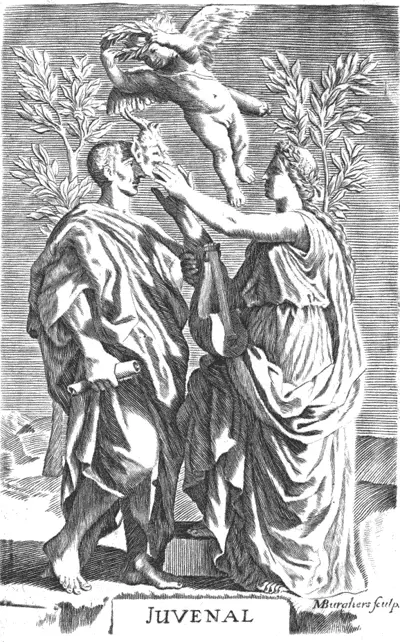
Decimus Junius Juvenalis (Latin: [ˈdɛkɪmʊs ˈjuːniʊs jʊwɛˈnaːlɪs]), known in English as Juvenal (/ˈdʒuːvənəl/ JOO-vən-əl), was a Roman poet active in the late first and early second century AD. He is the author of the collection of satirical poems known as the Satires. The details of the author's life are unclear, although references within his text to known persons of the late first and early second centuries AD fix his earliest date of composition. One recent scholar argues that his first book was published in 100 or 101. Because of a reference to a recent political figure, his fifth and final surviving book must date from after 127.
