Bertolt Brecht Quotes
For time flows on, and if it did not, it would be a bad prospect for those who do not sit at golden tables. Methods become exhausted; stimuli no longer work. New problems appear and demand new methods. Reality changes; in order to represent it, modes of representation must also change. Nothing comes from nothing; the new comes from the old, but that is why it is new.
Brecht, Bertolt. Brecht on Theatre: The Development of an Aesthetic. Translated by John Willett, Hill and Wang, 1964, p. 110.


She campaigned alone traveling throughout the South by train. She argued for change regarding civil rights. No First Lady had ever campaigned alone before, including Eleanor Roosevelt.


She was charged with interfering with the Draft during WWI. She wrote and gave speeches against the war and was convicted according to the laws and court interpretations of the time.

He traveled to Japan and stayed for the rest of his life and became a very respected Japanese writer. Japanese history had very periods of stability yet the Japanese progressed from a backward, insular, island nation to a highly technological, industrial, superpower in the presence of all the chaos and instability of government and society. The period after the Japanese defeat in the Second World War, has been the longest period of tranquility and stability in the history of Japan.


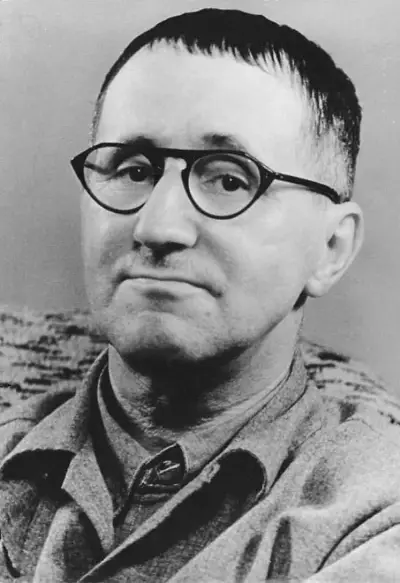
Eugen Berthold Friedrich Brecht, known professionally as Bertolt Brecht, was a German theatre practitioner, playwright, and poet. Coming of age during the Weimar Republic, he had his first successes as a playwright in Munich and moved to Berlin in 1924, where he wrote The Threepenny Opera with Kurt Weill and began a lifelong collaboration with the composer Hanns Eisler. Immersed in Marxist thought during this period, he wrote didactic Lehrstücke and became a leading theoretician of epic theatre (which he later preferred to call "dialectical theatre") and the so-called V-effect.
