David Ricardo Quotes
For price is everywhere regulated by the return obtained by this last portion of capital, for which no rent whatever is paid.
Ricardo, David. On the Principles of Political Economy, and Taxation. John Murray, 1817, p. 74.


His father Cornelius, one of the great, creative industrialists of America, was not at all of the same mindset and saw corporations and the Railroads as having an important role in America with substantial obligations to the society which enabled the economic development and supported the railroads. He described his son as a “blockhead”. William goes down in American history as the arrogant industrialist and capitalist whose wealth was produced by his talent of being born to the right father who built the great empire.

What is interesting about this quotation is that there was great argument at the time that business—in this case coal mining—had an obligation to provide safe working conditions for the miners, require reasonable work hours, and pay a fair wage. Baer and most other industrialists of the time were of the opinion that the only obligation that it owed was to its shareholders. Business had not moral or ethical obligations to workers. Theodore Roosevelt and the reformers of the day challenged that notion, and it seemed to have been resolved in the New Deal of FDR. However, in the last quarter of the 20th century, there was a conservative economic and political movement that went back to this position of Baer’s. While many corporations adapted that view in the 21st century, many did not, and some like Starbucks and Google urged an even greater ethical obligation to workers than ever.

Critics of his wondered how he, a world class neurosurgeon, would react to a political proposal to “throw the neurosurgeons out and use common sense instead.


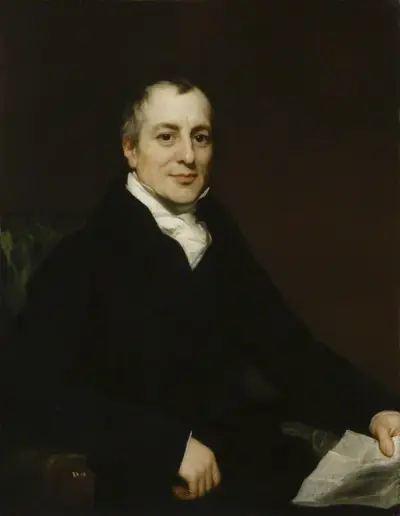
David Ricardo was a British political economist, one of the most influential of the classical economists along with Thomas Malthus, Adam Smith and James Mill. He was also a politician, and a member of the Parliament of Great Britain and Ireland.
