Milton Friedman Quotes
For one thing, there are many "inventions" that are not patentable. The "inventor" of the supermarket, for example, conferred great benefits on his fellowmen for which he could not charge them. Insofar as the same kind of ability is required for the one kind of invention as for the other, the existence of patents tends to divert activity to patentable inventions.
Friedman, Milton. Capitalism and Freedom. University of Chicago Press, 1962, p. 127.

This would seem a much easier solution to the problem of monopoly holders charging outrageous prices than trying to fix profits or lay a large tax on the profits. However, few governments ever do this. In many cases the patent holders control or heavily influence the government. There is in addition, in most Judeo-Christian societies an assumption that most people have a moral sense and will not take undue advantage of customers just because they have the power to do so. And in the most egregious cases of monopoly pricing there were many other patents where the inventors were not gouging the consumers. It is always been the minority of businesses that have taken gross advantage of patent monopolies. However at some periods, where there was an oligarchy, all the companies in an area abused their patent monopolies together. An example would be the pharmaceutical industry of the early 21st century.


Many people believe that patents—especially in the high technology arena—actually inhibit innovation.


When Secretary of State, Jefferson ran the first American Patent Office. The Patent system was originally and educational program, not an intellectual property program. Inventors would keep all their technological secrets to themselves. The idea behind the original patent system was to give an inventor a limited monopoly on profiting from his invention in exchange for sharing his information and techniques with his countrymen—thus improving the technological competency of the entire society. The very first patents were available for public inspection for that reason. And even today, copies of patents are available easily for almost no cost. And few American ideas worked as well as our early patent system. Through its educational role and technology transfer, America came from technological nowhere to being the pre-eminent inventing nation of the world. The balance between public access to invention and innovation and preservation of some rights to the creator of intellectual property is key to modern development.


One major purpose of the patent system is to get inventors to disclose their inventions and explain how they work and in exchange they get a temporary monopoly to profit from the invention. That is why all patents are available to the public so that science can advance if all other see how something was done. Despite the Douglas View, gadgets have been patented if they had some novel element to their functioning.

This principle justified the Government in allowing a local Indonesian company to manufacture anti-AIDS drugs without paying licensing rates demanded by the drug companies that held the patents. The principle is that patent rights and the desire to profit should not supersede the rights of people to continue to live because they cannot afford the drugs to keep them alive. The local manufacturers provide the drugs to the government at cost of manufacture which is a tiny proportion of the price the patent owner charges.


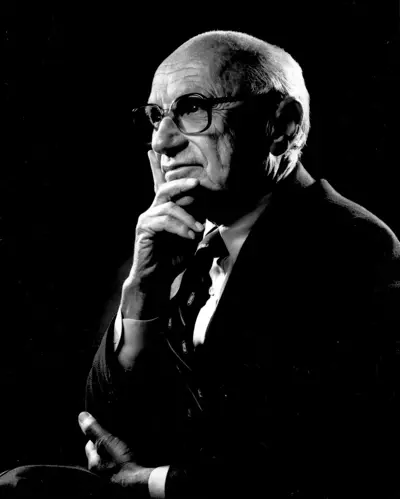
Milton Friedman was an American economist and statistician who received the 1976 Nobel Memorial Prize in Economic Sciences for his research on consumption analysis, monetary history and theory and the complexity of stabilization policy. With George Stigler and others, Friedman was among the intellectual leaders of the Chicago school of economics, a neoclassical school of economic thought associated with the work of the faculty at the University of Chicago that rejected Keynesianism in favor of monetarism until the mid-1970s, when it turned to new classical macroeconomics heavily based on the concept of rational expectations. Several students and young professors who were recruited or mentored by Friedman at Chicago went on to become leading economists, including Gary Becker, Robert Fogel, Thomas Sowell and Robert Lucas Jr.
