Sun Yat-sen Quotes
For forty years, I have devoted myself to the cause of the people's revolution with but one aim in view - the elevation of China to a position of freedom and equality among the nations.
Sun, Yat-sen. Fundamentals of National Reconstruction. China Cultural Service, 1953, p. v.


In the late 1830's a revolutionary political movement of small tenant farmers grew in upper New York State. There was much violence and anti-renters were hanged and jailed. After a few years they elected 14 members of the state legislature and had their fellows pardoned:


Mobutu with Amerucan CIA and French assistance deposed Lumumba, murdered him, and seized power.

Mao worked for a democratic reform in China and ending the single party rule of the Kuomintang. It was part of his communist theoretical concept that a democratic revolution is the first stage to be followed by the socialist revolution. Young Mao valued basic freedoms. However when the Communists finally attained power, freedom of speech, assembly and association no longer were important and were denied the Chinese people by the Communist Party which was the single party ruler just as the Kuomintang had been.
There had been a revolution against the Qing Dynasty and an attempt to establish a republic. Wang, the spokesperson, quickly wrote an article in the Atlantic Monthly one of the most prestigious American publications. He minimized the degree of bloodshed, but by Chinese standards of civil unrest where over 20 million people had been killed in previous discords, this was relatively benign. It was a de facto military coup which also involved political assassinations which he carefully avoided mentioning, and just a few months after the publication of this article a second revolution broke out and this version of the Chinese Republic was very short lived.


This phrase was also to be used over 100 years later by Malcolm X. See {624101} and {38291}.


He was elected to Parliament while in jail and never took his seat as he died as the result of a hunger strike in jail.
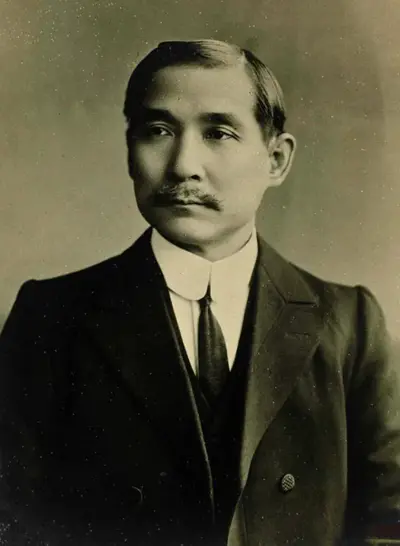
Sun Yat-sen was a Chinese statesman, physician, and political philosopher, who served as the provisional first president of the Republic of China and the first leader of the Kuomintang (Nationalist Party of China). He is referred as the "Father of the Nation" in the Republic of China, and as the "Forerunner of the Revolution" in the People's Republic of China for his instrumental role in the overthrow of the Qing dynasty during the Xinhai Revolution. Sun is unique among 20th-century Chinese leaders for being widely revered in both mainland China and Taiwan.
