Milton Friedman Quotes
For example, the supporters of tariffs treat it as self-evident that the creation of jobs is a desirable end, in and of itself, regardless of what the persons employed do. That is clearly wrong. If all we want are jobs, we can create any number--for example, have people dig holes and then fill them up again, or perform other useless tasks. Work is sometimes its own reward. Mostly, however, it is the price we pay to get the things we want. Our real objective is not just jobs but productive jobs--jobs that will mean more goods and services to consume.
Friedman, Milton, and Rose Friedman. Free to Choose: A Personal Statement. Harcourt Brace Jovanovich, 1980.


Although aggregate employment has remained relatively stable as global free trade has become the U. S. policy, there has been major employment disruption with some types of people benefiting and others like blue collar manufacturing workers having their entire careers wiped out. Port cities like Seattle, Baltimore have boomed while Midwestern manufacturing cities have deteriorated greatly.


Foreign trade creates jobs and eliminates jobs. The people who lost jobs as the result of increased foreign trade are readily identified while the job beneficiaries may never know the reason. So it is a hard political sell even though most of the economic studies have showed that more jobs of more value are created by trade than lost. However, the losers are generally blue collar workers while the beneficiaries are generally white collar and knowledge workers. So there is a socioeconomic class differentiation in the trade issue.


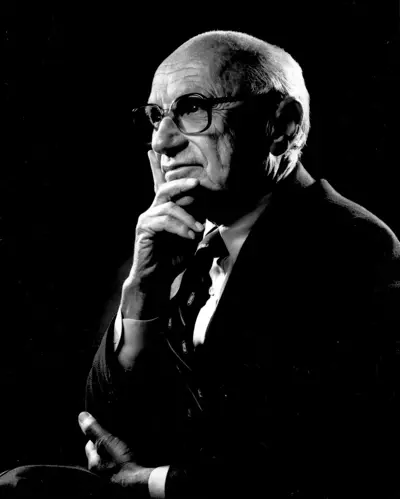
Milton Friedman was an American economist and statistician who received the 1976 Nobel Memorial Prize in Economic Sciences for his research on consumption analysis, monetary history and theory and the complexity of stabilization policy. With George Stigler and others, Friedman was among the intellectual leaders of the Chicago school of economics, a neoclassical school of economic thought associated with the work of the faculty at the University of Chicago that rejected Keynesianism in favor of monetarism until the mid-1970s, when it turned to new classical macroeconomics heavily based on the concept of rational expectations. Several students and young professors who were recruited or mentored by Friedman at Chicago went on to become leading economists, including Gary Becker, Robert Fogel, Thomas Sowell and Robert Lucas Jr.
