Robert M. Gates Quotes
Every president I worked for, at some point in his presidency, would get so pissed off at the Israelis that he couldn’t speak.
Robert M. Gates Quoted in Foreign Affairs. November/December 2016 Volume 95, Number 6
Sourced by: Eigen's Political and Historical Quotations

Netanyehu was one of the more frustrating heads of state to deal with. He had a personality that even annoyed his friends and supporters. His English was perfect and he could really annoy people he was meeting or negotiating with.


The Israeli’s had earlier been urged by America to give control of the Suez Canal back to Egypt. The Israeli’s held control of the Canal so that the Egyptians could not cut off ships from reaching Israel. The US had in exchange guaranteed that Israel would have free and unfettered access and to the sea. Egyptian dictator Gamal Abdul Nasser had just closed the Red Sea straights to the Israeli’s and the US was working on rolling that action back. However, some of the American oil companies privately were urging President Johnson to reneg on our commitments to our ally in order to ensure the profits of the oil companies. Johnson did not abandon Israel. ARAMCO made more money than ever. America was not finished in the Middle East.


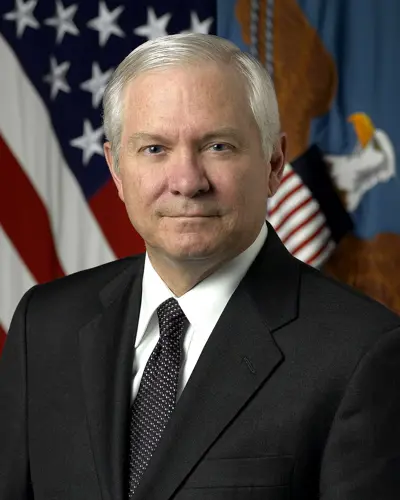
- Born: September 25, 1943
- Nationality: American
- Profession: Politician
Robert Michael Gates is an American intelligence analyst, and university president who served as the 22nd United States secretary of defense from 2006 to 2011. He was originally appointed by President George W. Bush and was retained for service by President Barack Obama. Gates began his career serving as an officer in the United States Air Force but was quickly recruited by the Central Intelligence Agency (CIA). Gates served for 26 years in the CIA and the National Security Council, and was Director of Central Intelligence under President George H. W. Bush. After leaving the CIA, Gates became president of Texas A&M University and was a member of several corporate boards. Gates served as a member of the Iraq Study Group, the bipartisan commission co-chaired by James A. Baker III and Lee H. Hamilton, that studied the lessons of the Iraq War.
