Thomas E. Dewey Quotes
Every American is dependent on every other American; that no segment of our people can prosper without the prosperity of all; that in truth we must all go forward together.
This quotation is cited by many to show that the Republican Party of the 1940’s and 1950’s was in many ways like the Democratic Party at the beginning of the 21st Century. This statement could easily be made by Bill Clinton with his “bridge to the 21st century” or any national Democratic leader in the 21st century while there are few Republicans who would dare make such a statement 50 years later. To other scholars, this quotation illustrates how far to the right the entire society has moved in the last 65 years of the 20th century. In 1948 this statement was made by the Republican presidential candidate and he was beaten badly by FDR whose programs were far to the left of his. By 2000, this statement would be made by the left or centrist members of the Democratic party while republicans who get roughly half the votes are far to the right.
Thomas E. Dewey, 1902-1971, Governor of New York (Republican), Republican Nominee for President, Presidential Campaign Speech and “Pledge to America,” delivered in Des Moines, Iowa, September 20, 1948
Sourced by: Eigen's Political and Historical Quotations


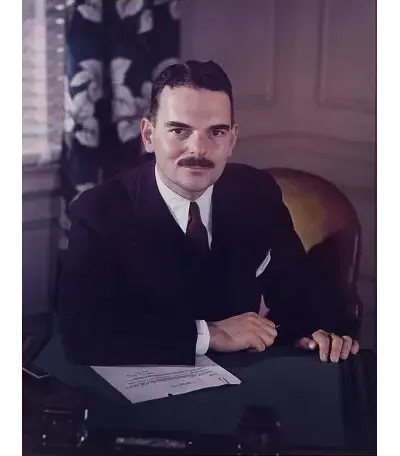
Thomas Edmund Dewey was an American lawyer, prosecutor, and politician. Raised in Owosso, Michigan, Dewey was a member of the Republican Party. He served as the 47th governor of New York from 1943 to 1954. In 1944 he was the Republican Party's nominee for president, but lost the election to incumbent Franklin D. Roosevelt in the closest of Roosevelt's four presidential elections. He was again the Republican presidential nominee in 1948, but lost to President Harry S. Truman in one of the greatest upsets in presidential election history. Dewey played a large role in winning the Republican presidential nomination for Dwight D. Eisenhower in 1952, and helped Eisenhower win the presidential election that year. He also played a large part in the choice of Richard Nixon as the Republican vice-presidential nominee in 1952 and 1956.
