Archimedes Quotes
Equal weights at equal distances are in equilibrium and equal weights at unequal distances are not in equilibrium but incline towards the weight which is at the greater distance.
Archimedes. The Works of Archimedes. Translated by Thomas Little Heath, Cambridge University Press, 1897, p. 189.


This quotation illustrates how scientifically sophisticated some of the Founding Fathers were.


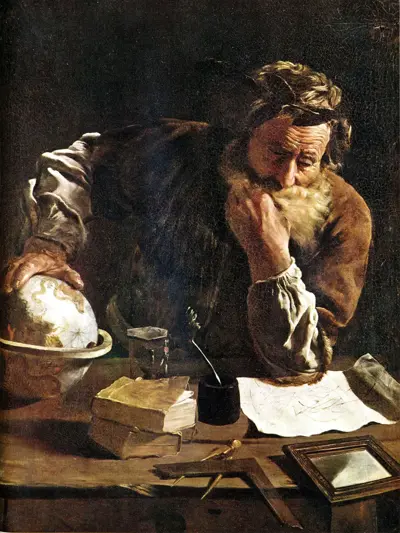
Archimedes of Syracuse (/ˌɑːrkɪˈmiːdiːz/; Ancient Greek: Ἀρχιμήδης; Doric Greek: [ar.kʰi.mɛː.dɛ̂ːs]; c. 287 – c. 212 BC) was a Greek mathematician, physicist, engineer, inventor, and astronomer. Although few details of his life are known, he is regarded as one of the leading scientists in classical antiquity. Considered to be the greatest mathematician of antiquity, and one of the greatest scientists of all time, Archimedes anticipated modern calculus and analysis by applying the concept of the infinitely small and the method of exhaustion to derive and rigorously prove a range of geometrical theorems, including: the area of a circle; the surface area and volume of a sphere; area of an ellipse; the area under a parabola; the volume of a segment of a paraboloid of revolution; the volume of a segment of a hyperboloid of revolution; and the area of a spiral.
