Karl Marx Quotes
Each piece of money is a mere coin, or means of circulation, only so long as it actually circulates.
Marx, Karl. Capital: A Critique of Political Economy, Vol. 1. Charles H. Kerr & Company, 1906, p. 130.


This is the first major history of banks written in the United States.


The alternative would have been for the colonies to borrow English money at high interest rates and use that. Or use money from private banks (which occurred later.) Many conservatives are today a little shocked that some of the American Colonies just printed money with no backing but it worked—at least at the local level. A Boston Bank for example, would take a large commission for a Bostonian to convert Pennsylvania money into Massachusetts money. So it was not a very good system for trade between colonies and International trade. But English money was used for that. The colonists pragmatically got the “best of both worlds” and paid as little interest as they needed to. This system is essentially what we use today on a national scale with no gold or silver backing of the money.

The Empress at that time had never interacted with Westerners as Chinese culture regarded them as barbarians and it would be an insult to the Empress to even be in their presence. All she knew of the British was what her nobles had reported to her. A British army, under General “Chinese” Charles Gordon had been assigned by London to aid the Chinese Government to suppress the Taiping Rebellion, which it did. The Empress began to see for herself some of the behavior of the British—see {641821} and was developing and independent view of the foreign barbarians. After Gordon was successful in defeating the rebels, the Empress ordered that he be rewarded with 10,000 silver Taels—a small fortune. Her commanding general who had offered the reward had to report that Gordon refused stating that he was not a mercenary but a general commanding British Forces in service to Queen Victoria. Cixi was not only impressed by Gordon’s integrity and loyalty to his country, but was beginning to learn that the “facts” about the foreigners had not been reported accurately.

This quotation was particularly interesting for Americans of the early 21st century by which time, the United States had become the greatest debtor nation in the world.

This was a very astute prediction. At the time, the United States gold mining production was second only to South Africa and American currency was based on the gold standard which seemed to all to be permanent. Half a century later, the U. S went off the gold standard.


Most people owned a little land as most of America were still farmers. They had small amounts of money at different times but spent it for necessities. A relatively few people (mostly in the East) had money—gold and paper currency backed by gold. If the price of property was high, only rich could afford to buy it. The home mortgage system did not then exist, so there was no way that the average land owner could get enough money to buy land to expand farms or buy for children unless the price was low. Today, most land owners want the price of land to be high. The financial system in use at the time makes the difference.
At the time any private bank could issue their own money. Private sector bankers thought it outrageous that the Congress should consider trampling on their rights to issue money. The solution that was finally adopted some years later was to use the Federal Reserve Board to control the money supply. It is independent of the Congress and the President but members are appointed by the President and confirmed by the Senate. Our system, like no other system, is a compromise where neither the Government or the Private Sector controls the American money supply.
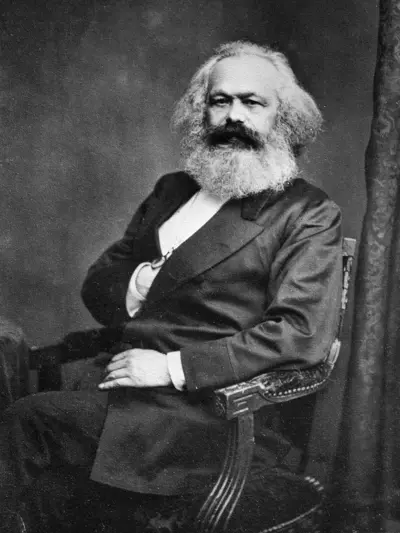
Karl Heinrich Marx was a German philosopher, economist, historian, sociologist, political theorist, journalist and socialist revolutionary. Born in Trier, Germany, Marx studied law and philosophy at university. He married Jenny von Westphalen in 1843. Due to his political publications, Marx became stateless and lived in exile with his wife and children in London for decades, where he continued to develop his thought in collaboration with German thinker Friedrich Engels and publish his writings, researching in the reading room of the British Museum. His best-known titles are the 1848 pamphlet The Communist Manifesto and the three-volume Das Kapital (1867–1883). Marx's political and philosophical thought had enormous influence on subsequent intellectual, economic and political history. His name has been used as an adjective, a noun, and a school of social theory.
