Ernestine Rose Quotes
Do you tell me that the Bible is against our rights? Then I say that our claims do not rest upon a book written no one knows when, or by whom. Do you tell me what Paul or Peter says on the subject? Then again I reply that our claims do not rest on the opinions of any one, not even on those of Paul and Peter, ... Books and opinions, no matter from whom they came, if they are in opposition to human rights, are nothing but dead letters
Response to a heckler, Seventh National Woman's Rights Convention, New York, November, 1856
Sourced by: Eigen's Political and Historical Quotations

Most politicians and philosophers would argue that liberty is both an individual right and a group right. However there are money who do not recognize group rights and feel that they are inimical to individual rights.


See {620508} for how far he is willing to take this principle.


Jefferson had deliberately modified John Locke’s phrase “life, liberty and property.
Those who support the right of the individual woman to use contraception or have an abortion cite this quotation to illustrate this early statement of the right of a person to have control over his or her own body.

This quotation is probably the beginning of the false charge that liberalism always rejects God and divine law. Most liberals, since the term has been used, have been religious and even those who were not did not see liberalism as necessarily antithetical towards religion. However, most doctrines of liberality had toleration and religious freedom as part of its foundation. To authoritarian religious leaders who did not believe in toleration (see {609037}) the very toleration of dissenters is tantamount to dissent. Today, for example, many liberals tolerate atheists and non Christian religions even though most are Christians themselves. To some narrow conservatives, this principle of toleration is therefore equivalent to being against religion. To others, modern liberal belief of separation of church and state is seen as anti religious.


Crockett and a large group of Tenesseeans all died defending the Alamo for the Liberty and Independence from the Mexican Dictator, Santa Anna.

This is a very important political, historical, and philosophical quotation. This is a view that is very common amongst many Americans—especially those who are religious. As a factual matter, it is not clear that ALL the founding fathers personally believed in the creator--God. All the views have never been discerned. However it is almost certain that the majority of the Founders so believed. The complication with taking this viewpoint too literally is that while our rights may have come from God, it is men who determined exactly what rights would be enumerated on our constitution. For example. the original draft of the Constitution did not include, the right to a free press, the right of due process, the right of being free from religious compulsion and others. Yet it passed. Then other men and women wanted more rights added and the Constitution was ratified on condition that the Bill or Rights would be incorporated as the first 10 amendments. There were other rights that were not explicitly mentioned. For example, there is no right to an education mentioned in the Constitution or any of the amendments. Blacks had no rights until additional amendments were passed. And later there was an amendment that denied Americans the right to drink alcohol. Then another that gave the rights back. There are rights that other nations have which we do not—ie the right to medical care. Which if these did God grant and which, not? So even if we assume that every one of the founding fathers not only believed in God, but believed the rights were all God given, we would still be in the practical dilemma of having to specify the language of each right and always to, by amendment, adding additional rights or modifying or even deleting older rights. Many believe that Americans were divinely inspired when we added (or changed) rights. Others, not. However, regardless, we must go through the same procedures of enumerating American rights and amending the constitution. So the process is the same for both those who believe that our rights come from God and those who do not. To change rights, we need the action of Americans divinely inspired or otherwise, but they can and have been changed. For example, before 1963 Americans did not have a right to use birth control devices. After the Supreme Court Griswald v. Conn. We did and now have a right to use birth control devices. The mode that rights are manifested, defined, enumerated and implemented is a political one—one that in our American system allows us all to implement that system whether or not we believe that our rights come from our Creator.
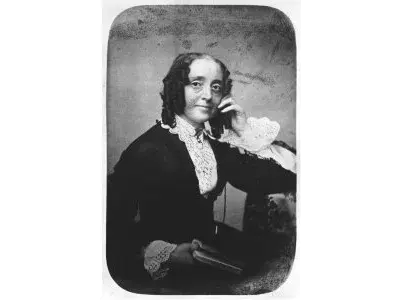
Ernestine Louise Rose was an atheist feminist, individualist feminist, and abolitionist. She was one of the major intellectual forces behind the women's rights movement in nineteenth-century America.
