Henry David Thoreau Quotes
Do we call this the land of the free? What is it to be free from King George and continue the slaves of King Prejudice? What is it to be born free and not to live free? What is the value of any political freedom, but as a means to moral freedom? … We are a nation of politicians, concerned about the outmost defenses only of freedom. It is our children's children who may perchance be really free..
Henry David Thoreau, 1817-1862, Writer, Life Without Principle, 1863
Sourced by: Eigen's Political and Historical Quotations


This is a particularly memorable quotation for several reasons. First the address was given by a young senior student who would later be a member of Congress, a effective abolitionist, and the author of various pieces of legislation that vexed the South. What is even more memorable is that the oration was given at an Ivy League College Official Graduation. The Ivy league schools, despite their reputation for intellectual freedom, generally were very adverse to any discussion about the slavery issue as it would cause too much passionate contention. See {621346} for an example at Harvard. In addition, Brown University was in Providence RI, where the economy depended in substantial part on slavery. The Co-Founder of Brown was himself a slave trader {622028}. This was one of the early American anti-slavery orations.

Beaumarchais served the French King Louis XVI as a spy and advisor on foreign affairs. He was instrumental in influencing the French King and his government to tilt in favor of the American Revolutionaries. Beaumarchais’s reaction to the English was typical of European royalists who saw the political infighting and turmoil of a parliamentary government as frantic and destabilizing. Ironically, most Frenchman preferred it and that led to the French Revolution.


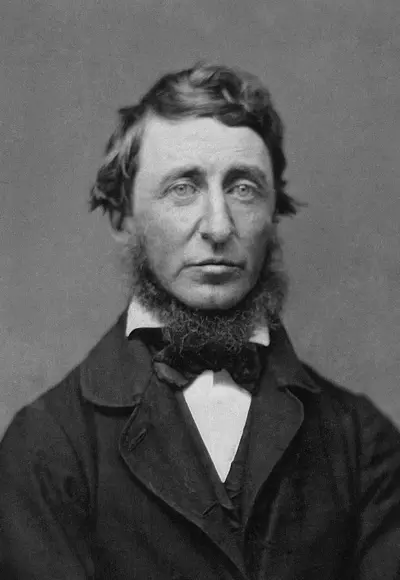
Henry David Thoreau was an American naturalist, essayist, poet, and philosopher. A leading transcendentalist, he is best known for his book Walden, a reflection upon simple living in natural surroundings, and his essay "Civil Disobedience" (originally published as "Resistance to Civil Government"), an argument for disobedience to an unjust state.
