Rutherford B. Hayes Quotes
Disunion and civil war are at hand; and yet I fear disunion and war less than compromise. We can recover from them. The free States alone, if we must go on alone, will make a glorious nation. Twenty millions in the temperate zone, stretching from the Atlantic to the Pacific, full of vigor, industry, inventive genius, educated, and moral; increasing by immigration rapidly, and, above all, free--all free--will form a confederacy of twenty States scarcely inferior in real power to the unfortunate Union of thirty-three States which we had on the first of November.
Hayes, Rutherford B. Diary and Letters of Rutherford Birchard Hayes, Volume 2. Edited by Charles Richard Williams, Ohio State Archaeological and Historical Society, 1922, p. 3.


This quotation is very important in that this is the first record that Lincoln had any doubts that he might not be able to preserve the Union.


It would be almost 30 years until Jackson would have been proved correct and the Civil War had begun.


Eggleston was an accomplished writer who had served in the Confederate army of the Civil War. 20 year after the war he wrote a series of articles for the prestigious Northern Atlantic Monthly trying to convey the war from the Southerner’s point of view.

Seward, the newly appointed Secretary of State was extremely concerned that if the radical direction that many of the Southern States were moving in turned into a Civil War, that the Union should not be seen as the precipitating initiator. His policy was followed and the secessionist extremists, not so politically sensitive, attacked Fort Sumter and became the initiator of the war so far as public opinion was concerned domestically and internationally. It was very important for the Union effort that the Confederates by seen as a group of radicals rebelling against the authority of a legitimate state. If that was the case, any effort to aid or help the South could be seen as an unfriendly act of war against the United States. Conversely, the South would have liked to be seen as an independent nation, no longer connected to the United States and entitled to diplomatic relations and foreign trade with all other nations. But the attack on Fort Sumter made that position much harder to maintain.


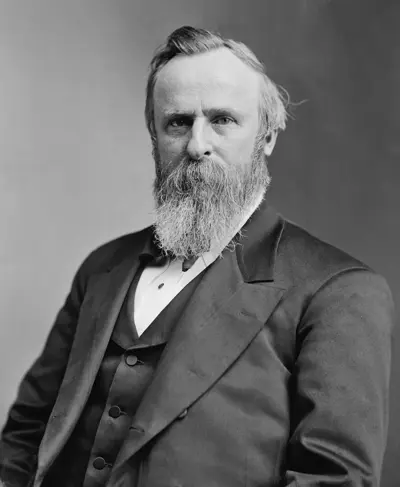
Rutherford Birchard Hayes was an American politician and attorney who served as the 19th president of the United States from 1877 to 1881, after serving in the U.S. House of Representatives and as governor of Ohio. A lawyer and staunch abolitionist, he had defended refugee slaves in court proceedings during the antebellum years. He negotiated the political agreement to end federal support of Reconstruction.
