John F. Kennedy Quotes
[Describing the presidency:] No one in the country is more assailed by divergent advice and clamorous counsel.
John F. Kennedy, 1917-1963, 35th President of the United States (Democrat, MA), Introduction to Sorenson, Decision Making in the White House, 1963
Sourced by: Eigen's Political and Historical Quotations


Some people get upset when they learn that members of the President’s cabinet disagreed with the president on a major policy. Yet this is very common and very desirable as long as when the President reaches his/her decision, the dissenters all close ranks and implement it. Some Presidents are not secure enough or confident enough to be comfortable with dissent. The greatest of our Presidents were known for their selection of strong advisors who have different perspectives. President Lincoln had all his rivals for the Presidency in his cabinet. Franklin Roosevelt appointed a number of Republicans to his cabinet and a left wing socialist also. Theodore Roosevelt’s Secretary of State, Elihu Root, was famous for telling the President where Root thought he was wrong. George Washington had Thomas Jefferson and Alexander Hamilton in his cabinet and they fought like cats and dogs. Jefferson ran against Washington’s Federalist party and destroyed that party at the polls. However, the nation was better for these brilliant, experienced cabinet members helping a strong President to make consider all possibilities and make better decisions.


This is one of the more candid and honest description of the reality of a new Presidential Administration making the transition from the old administration.

This point of view is contentious in that many people (usually those at the extreme left and extreme right) think that the intention of the founding fathers was to avoid a single executive from starting a war unilaterally. Congress was given the power to declare war—not the president. Arguably public opinion is reflected by Congress, but going to war, when public opinion has been opposed to it has always turned out badly in American History.


Actually, there are many in politics who to this day castigate Truman for his decision, but for Bloomberg’s generation and before, anyone would have pushed the button. And there are some who still fault Obama as technically, the U. S. had no right to violate Pakistani airspace and kill a resident of their state without any due process in the U. S. or Pakistan. Bloomberg would have easily pushed that button, but there are many officials who warned against it, and earlier Presidents—George W. Bush and Bill Clinton who did not authorize assassinations in foreign (allies) countries.


Bush assumes that this meant that all the people agreed with his decision to invade Iraq. While that might have been the case, there are other possibilities that many historians, journalists and other analysts have suggested. The Vice President, and his personal staff, were known to have visited them all and lobbied for the invasion. They pressured several of them who may have not wanted to run afoul of what seemed to be the most powerful vice president in American History. Or they may have thought that the decision had already been made, and it was time to join together and loyally support the policy decision that had been made. There were few strong independent thinkers in the top tier as Bush was not intellectually or emotionally inclined to have open staff arguments to work out a policy or very strong advisors with different points of view. The strongest of the advisors like Secretary of State Colin Powell had been lied to and persuaded there was “clear evidence” that Iraq was about to deploy a nuclear weapon. This made Powell an advocate. The intelligence given to Powell and the others was wrong and much was fabricated or obtained from an unreliable source who had been pushed as trustworthy by the Vice President. The CIA Director, had told those all that the evidence and case for the fact that Iraq was developing and close to deploying a nuclear weapon was a “slam dunk”.
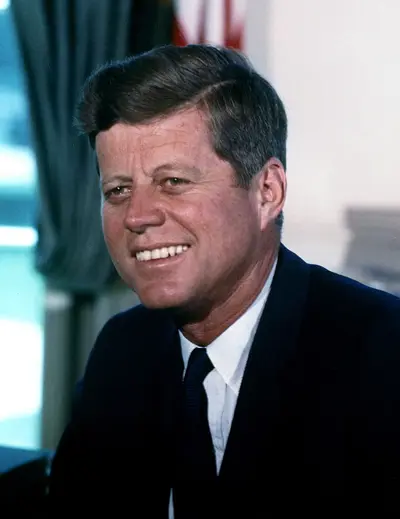
John Fitzgerald Kennedy, often referred to by his initials JFK, was an American politician who served as the 35th president of the United States from 1961 until his assassination in 1963. Kennedy served at the height of the Cold War, and the majority of his work as president concerned relations with the Soviet Union and Cuba. A Democrat, Kennedy represented Massachusetts in both houses of the U.S. Congress prior to becoming president.
