David Crockett Quotes
[Describing Congress:] We generally lounge or squabble the greater part of the session, and crowd into a few days of the last of the term three or four times the business done during as many preceding months.
David Crockett, 1786-1836, U.S. Congressman (Democrat, TN), Quoted in The Life of Davy Crockett, Keystone, 1889
Sourced by: Eigen's Political and Historical Quotations

The objective of a large proportion of the Congress then was not to improve the nation or even pass legislation, but to preserve their ideology and attack and weaken the other party. Compromise for example is probably the best legislative practice, but that Congress had a substantial number of Tea Party and other ultra conservatives who believed that any compromise at all was an immoral abandonment of principle.


His Republican Party had filibustered more bills in the Senate then had been done previously in all of the Senate History together. Congress passed fewer bills in his first two years than any other Congress in history.


The congressman was reacting to a group staging a protest on the bridges connecting Washington DC with Virginia, thereby stopping traffic.

Conservatives in the Senate were filibustering the bill at the time.


This was a very courageous statement by the President because it was his own Republican Party that tended to be the most hostile an partisan. However, where some in Congress listened to his advice, the pressure from the extreme right wing pressured the entire Republican party to new extremes of partisanship and vituperation and under the succeeding President Obama, many Republicans would not support positions that they had formerly voted for and/or advocated because they were favored by the Democratic President or other Democratic leader.

In 2007 the Republicans, who were in the minority, began to use the filibuster to a degree that it had never been used. Within the single year of 2007 Republican’s filibustered 62 times, doubling the highest rate that had occurred before. A small minority of senators were able to block legislation that easily passed the House and was supported by the majority of senators and in some cases supported by the overwhelming majority of the American Public.

With its multiplicity of committees and the polarization of the parties, Congress has been unable to legislate on large, comprehensive problems that involve more than a single issue at a time.

This was one of the most remarkable statements made by a Congressional leader. At the time, the Congress was in the midst of one of the worst stalemates in American Political History. The national debt limit had to be raised in order to legally pay for the expenses that the Congress had voted for and the President had approved. A minority of the House—the Tea Party--tried to use the necessary legislation to get a program of theirs legislated when they did not have the votes to pass it in both houses of Congress. The House would not approve any solution that the Senate would pass, and the Senate would not pass any of the House proposals. The Boenner and the President had reached a compromise but the minority of his own party refused to go along and threatened to oust the Speaker and not vote for the Compromise. To them, compromise was surrender and doing business as usual. At the same time, the left wing of the President’s party did not want to vote for the Compromise plan that the President and the Speaker had worked out. Then the Minority Leader of the Senate, create a new plan that would transcend solve the immediate problem and defer the larger issues which would continue to be debated. The Senate Majority Leader agreed to go along with it and so did the President, but the Minority Leader’s fellow Republicans in the House refused to vote for that compromise. The President and then Boenner went on national television sequentially to explain the situation and the Speaker made this famous quotation, Boenner, we caught in an impossible situation. His Tea Party faction insisted that there need not be a stalemate. The President and the Senate needed the debt limit raised and they would have to give in and vote for the Tea Party plan. Almost all of the Tea Party members were new to Congress and Bonner realized that an entire party who controlled the Senate would never be blackmailed that way, and even if they did, the President would Veto. Yet his own deputy was preferred by the Tea Party and some others, so if Boenner tried to act statesman like, he was risking his speakership. So he became the spokesperson of the Tea Party wing and denied what 90 percent of all Americans knew to be true. Usually absurd statements clearly contrary to the facts at the time are the results of mistakes or gaffs. Occasionally, a more complex situation explains it.
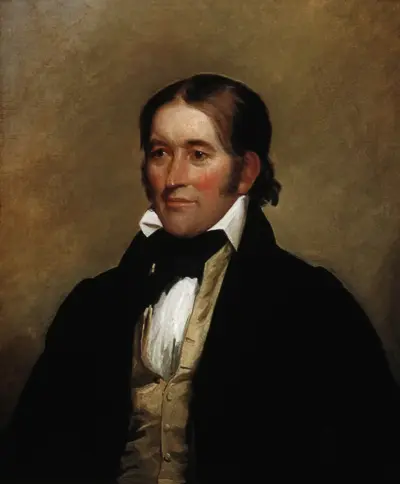
David "Davy" Crockett was a 19th-century American folk hero, frontiersman, soldier, and politician. He is commonly referred to in popular culture by the epithet "King of the Wild Frontier". He represented Tennessee in the U.S. House of Representatives and served in the Texas Revolution.
