Albert Einstein Quotes
Democracy, taken in its narrower, purely political, sense, suffers from the fact that those in economic and political power possess the means for molding public opinion to serve their own class interests. The democratic form of government in itself does not automatically solve problems; it offers, however, a useful framework for their solution. Everything depends ultimately on the political and moral qualities of the citizenry.
Einstein, Albert. Quoted in Calaprice, Alice. The Ultimate Quotable Einstein. Princeton University Press, 2010, p. 144.


See {619285} for another of his quotes about the wealthy.

Samuel Langhorne Clemens, 1835-1910. Even in a democracy, governments often enact laws that the public disapproves of and fails to enact others that the public wants. Most taxes are examples of the former; gun control legislation, of the latter.

In modern America, there are two political views of this notion. The one held by a narrow majority of the population is Trenchard’s quotation taken literally. Their view is that there is no way to maintain liberty if there is too wide a wealth gap between the rich and the rest of the population. The second variant, held by many conservatives, limits the equality to equality of opportunity. They are loathe to take any position that says that any gap between the rich and the remainder of the citizens might be too large. They would particularly disagree with the first sentence of this quotation. Another consideration is that this quotation does not even consider what became a major problem in the American Democracy—the ability and propensity of the very rich to bribe legislators and officials and/or make “campaign contributions” to obtain favorable treatment and/or “access”.


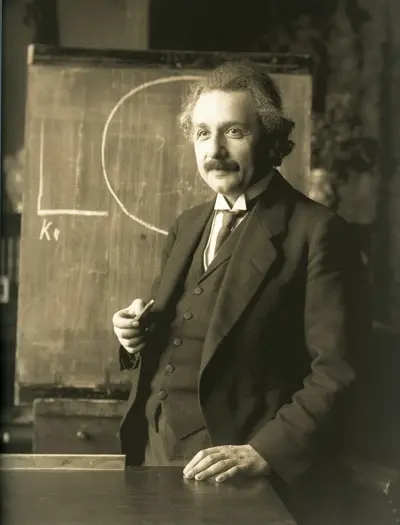
Albert Einstein was a German-born theoretical physicist, widely acknowledged to be one of the greatest physicists of all time. Einstein is known for developing the theory of relativity, but he also made important contributions to the development of the theory of quantum mechanics. Relativity and quantum mechanics are together the two pillars of modern physics. His mass–energy equivalence formula E = mc2, which arises from relativity theory, has been dubbed "the world's most famous equation". His work is also known for its influence on the philosophy of science. He received the 1921 Nobel Prize in Physics "for his services to theoretical physics, and especially for his discovery of the law of the photoelectric effect", a pivotal step in the development of quantum theory. His intellectual achievements and originality resulted in "Einstein" becoming synonymous with "genius".
