Louis D. Brandeis Quotes
Decency, security and liberty alike demand that government officials shall be subjected to the same rules of conduct that are commands to the citizen. In a government of laws, existence of the government will be imperiled if it fails to observe the law scrupulously.
Louis D. Brandeis, 1856-1941, U. S. Supreme Court Justice, Dissent, Olmstead et al. v. United States, 1928
Sourced by: Eigen's Political and Historical Quotations


This principle has been in force since the beginning of our republic. However, there was a suggested challenge to it by President Richard M. Nixon, and a substantial challenge by the George W. Bush Administration which took the position that as long as the President was engaged in carrying out a Constitutionally mandated function, like war or foreign policy, the President did not have to obey the existing laws and could direct his subordinates to violate the law. Bush lost in those areas which came to the courts and the Supreme Court made it clear that even the President, carry out his official duties, had no immunity from the laws of the nation.

_0_thumbnail_47x47.jpg "Statue of Robert Hall in Leicester.")
For many people the implication of this quotation is that there should be no government secrets withheld from the citizens who have the right to examine. Others argue that government may have temporary secrets to protect against foreign enemies for example, but that these must be declassified very promptly so that the citizens can examine the actions of their government in time to replace the government if they are not satisfied. Almost all government officials tend to reject the first implication out of hand, and grudgingly accept the second with their discretion controlling when declassification should take place. The problem of America is twofold. There is much over-classification (material kept secret that should not be at all), and the time till declassification is long in general and truly absurd in many cases. For example, there are documents from WWII that by 2013 had still not been declassified. See {591444}, {641317}, and {589105} for exemplar views. William Jennings Bryan introduced this principle into the American political dialogue. See {641027}.

The Egyptian Army, responding to huge demonstrations, ordered the Muslim Brotherhood President to step down in what appeared to be a coup d’etat. There was an American law that required a cut off of foreign aid to any government that had come to power. The American Administration and most of Congress did not want to terminate foreign aid to Egypt, and announced that it could not come to a conclusion as to whether or not there was a coup. They did not say that there was no coups—they just decided not to decide. Since there was no finding of a coups, there was no cutoff. Senator Paul and a few other Senators, observing that there had been a coup, wanted the administration to cut off the foreign aid even though it would be detrimental to our foreign policy. The government must obey the law they argued, regardless of the consequences.


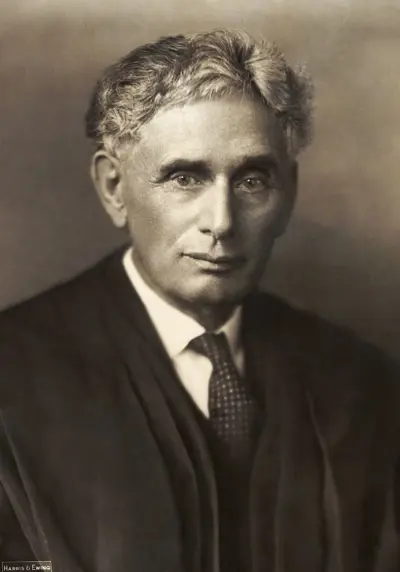
Louis Dembitz Brandeis was an American lawyer and associate justice on the Supreme Court of the United States from 1916 to 1939. He was born in Louisville, Kentucky, to Jewish immigrant parents from Bohemia (now in the Czech Republic), who raised him in a secular home. He attended Harvard Law School, graduating at the age of 20 with the highest grade point average in the law school's history. Brandeis settled in Boston, where he founded a law firm (that is still in practice today as Nutter McClennen & Fish) and became a recognized lawyer through his work on progressive social causes.
