Samuel P. Huntington Quotes
Corruption can be a lubricant reducing the friction between new elites and old elites in a period of rapid change.
Samuel P. Huntington, 1927–2008, Political Scientist, Director of Planning, National Security Agency, President, American Political Science Association, Quoted by Walter A. McDougall, Speech, Foreign Policy Institute, May 13, 2004
Sourced by: Eigen's Political and Historical Quotations


Smith had written to most of the then likely Presidential candidates of both major parties asking for their position on the Mormons who were facing persecution wherever they went. None of the politicians would make and satisfactory commitments. Smith took Direct Action and became the only major religious official to have run for the Presidency of the United States until Pat Robertson tried and failed in 2000. Smith’s assassination shortly thereafter cut his run for the Presidency short before it made much headway and politically he had no chance to affect the race.

What was remarkable was that all the Defense Department and military witnesses agreed with Lynch on this point.


Most people at the time thought that political corruption was limited to politicians being bribed with money to do or not to do things. It dawned on Stephens that beyond the payment of money per se—that it could involve financial arrangements like shares in companies or tips for investment, business arrangements for family companies then or in the future or even social favors. He was the first political observer to not the variety of forms of political corruption.

The United States had just ousted the popularly elected leader Patrice Lumumba {640611}, and backed Mobuto. Lumumba was an idealist who was not corrupt at all, but were not so sure about our new protégé. Sadly he turned out to be one of the worst kleptocrats of all time, and he stole with more United States money than we gave to many nations in toto. Many believe that one of the reasons, corruption of our “allied” leaders was so bad lies in the wording of this cable. Note that to the State Department writers there was “normal” corruption as opposed to excessive corruption. Once that view is taken there is a constant battle to determine whether each new act of corruption is “normal “ or not, and corruption is simply lessened by pushing back against the most abnormal schemes. These critics advocate a zero tolerance for corruption especially with United States AID money. The State Department has been ambivalent and have often used the corruption system to bribe leaders to obtain national objectives.


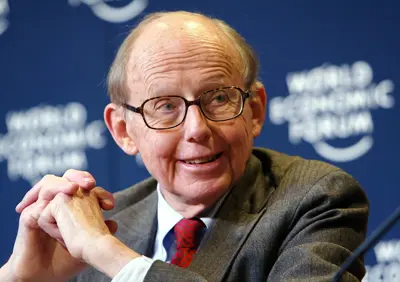
Samuel Phillips Huntington was an American political scientist, adviser and academic. He spent more than half a century at Harvard University, where he was director of Harvard's Center for International Affairs and the Albert J. Weatherhead III University Professor.
