Vannevar Bush Quotes
Consider a future device for individual use, which is a sort of mechanized private file and library. It needs a name, and, to coin one at random, "memex" will do. A memex is a device in which an individual stores all his books, records, and communications, and which is mechanized so that it may be consulted with exceeding speed and flexibility. It is an enlarged intimate supplement to his memory.
What he called a “memex” is essentially what a PC, a tablet, or a smart phone would do in 2010. Bush was a great visionary and was appreciated by politicians as such. Bush had advised FDR to go ahead with the research and development program to try and develop an atomic bomb. He was the only Government Official who Roosevelt discussed the idea with. At the time, Bush as a government official supervised and directed many thousands of scientists, and was one of just a few scientists who monitored and advised on the Manhattan Project to develop the Bomb.
Vannevar Bush, 1890-1974, Director of the U. S. Office of Scientific Research and Development, Vice President of MIT and Dean of the MIT School of Engineering, Founder of Raytheon, Presidential Science Advisor (Franklin Delano Roosevelt), “As We May Think”, July 1, 1945
Sourced by: Eigen's Political and Historical Quotations

See {68645} for his vision of how this would be done.


The collection of quotations, its cross references, concepts, and search engine is just the kind of thing that Bush was predicting.


This seemingly beneficial objective began to develop serious opponents as Google began to index more and more of the knowledge of the society. Vested copyright interests, scholars, civil libertarians, privacy advocates, and forces in control of information all discovered consequences.

Technology has always displaced and replaced workers, but most industrial technological breakthroughs, in the long run, have created new jobs and better paid ones. What worried Gompers did not appear to materialize in his lifetime, but actually became and issue on the later years of the 20th century and the early 21st century where the computer the robot, and the sophisticated software began to replace workers at a faster rate than new opportunities were created. Gompers was one of the harbingers of things to come.


He was one of the team that created the first Atomic Bomb. In 1946, the atomic bomb was known about by almost all Americans and almost no one had even heard of a computer or the concept of a computer. The British and Americans during the war had collaborated to build very limited electronic calculating machines but the concept of programs to control the calculating machines was new—initially created by van Neumann and Englishman Alan Turing. When he made this statement most people thought it was the ravings of a “mad scientist. He was one of the team that later developed the first real computer at the Institute for Advanced Study at Princeton.”


He was referring to projects like the ObamaCare website. This was then only the most recent failure of a major IT government project. The IRS has for years been unsuccessful and developing a system for tax filing. And the Defense Department tried to develop a standardized programming language—ADA—that failed miserably despite all the pressure the government put on companies. Microsoft and Google rarely meet their own internal deadlines for development of a major innovative product, and that is typical as there is risk in many parts of a system and further risk as to whether they work together, and then whether they work with heavy use, etc.


In the1969 mission to the moon, the lunar module control computer flashed a Program Alarm warning message, and the Mission Control officer Steve Bates, with less than 30 seconds to go, had to make a decision whether to abort the module landing or continue. He spoke to Garman, who concluded that since the message did not repeat, that the message was most likely a spurious message—a false alarm. German told him to go ahead when most others wanted to abort. As Garman was the most familiar staff member with the software, Bates followed his lead and continued the landing. Garman was right and he became known as “The Man who saved the Moon Landing”.

In addition to the hackers who break into websites for monetary gain, or spying for companies or governments, there are many why just love the challenge of hacking into computers and websites that authorities claim is secure. The reality is that there is no way to absolutely sure a computer or its contents as long as it is connected to the Internet. Those computers and sites that have nothing to hide and do not present a challenge to hackers of this type rarely have problems from them; their vulnerability is to the other hacker who can utilize their computer slo hack still others of paralyze their computer to extract a ransom for functionality. The analogy of the hackers to the barbarian hordes sacking Ancient Rome and the Mongolian hordes sacking Europe is one that many appreciated,

Computers, robots have replaced many more American workers than those who lost their jobs by having them replaced by foreign labor. Ironically, even in counties like China, South Korea, and a number of others, have "liost" millions of jobs to automation thenselves.


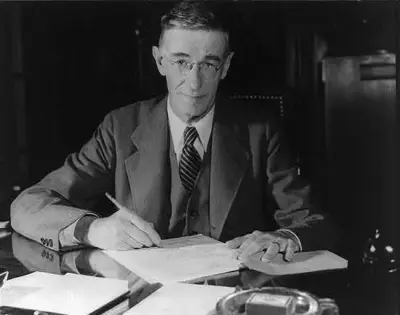
Vannevar Bush was an American engineer, inventor and science administrator, who during World War II headed the U.S. Office of Scientific Research and Development (OSRD), through which almost all wartime military R&D was carried out, including important developments in radar and the initiation and early administration of the Manhattan Project. He emphasized the importance of scientific research to national security and economic well-being, and was chiefly responsible for the movement that led to the creation of the National Science Foundation.
