Ernest Renan Quotes
Communism is in conflict with human nature.
Renan, Ernest. The Apostles. G. W. Carleton, 1866, p. 132.

Ataturk was not receptive toward Communism as some other world leaders were at the time. He saw its weakness far earlier than many others.


Unlike most of his televangelist successors, Sheen was very ecumenical. He was clearly Catholic but had a very significant Protestant and Jewish Audience.


Hoover’s testimony not withstanding, communism in America never did spread like an epidemic.

This line was a takeoff on the famous quotation of Karl Marx: {624064}.


Socialism in its then pure form had the state owning and controlling all the major assets of the nation. In this sense it was contradictory to individual freedom and hence democracy. However, in the years after Tocqueville’s quotation and the industrial revolution, socialism has gradually moved away from state ownership and operations of all institutions and resources. Democracy has tended to adopt a more regulatory view to control the excesses of unbridled capitalism. The range of democratic nations by the 21st century encompassed differences but some were described as “social democracies” and had some state ownership but were basically capitalistic economies. Even the self-described Communist nations had become heavily capitalistic albeit with less political freedom. At the same time, even the United States—the epitome of 21st century capitalism, owned and controlled a few of the resources and means of production and tended to regulate the others—a substantial difference from the American democracy which Tocqueville studied.


Despite the fact that many conservatives labeled him a Communist, he not only saw them as different but was very critical of the failure as he saw it of Russian Communism. See {626693} .
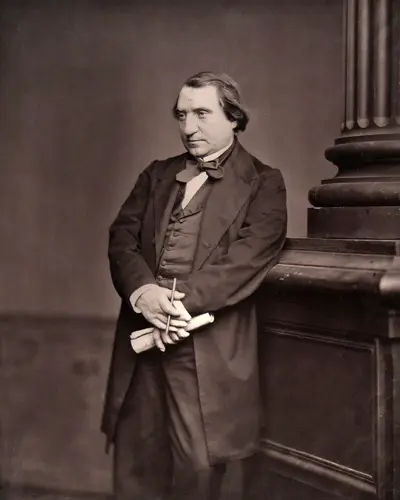
Joseph Ernest Renan was a French Orientalist and Semitic scholar, expert of Semitic languages and civilizations, historian of religion, philologist, philosopher, biblical scholar and critic. He wrote influential and pioneering historical works on the origins of early Christianity, and espoused popular political theories especially concerning nationalism and national identity. Renan is credited as being among the first scholars to advance the now-discredited Khazar theory, which held that Ashkenazi Jews were descendants of the Khazars, Turkic peoples who had adopted Jewish religion and migrated to Western Europe following the collapse of their khanate.
