Chrystia Freeland Quotes
Canada did not have a financial crises just because the Canadian Government said “No” to their bankers.
in the meltdown of 2008
Chrystia Freeland, Canadian Writer, Journalist & Editor, Managing editor at the Financial Times, C-SPAN Book TV, October 23, 2012
Sourced by: Eigen's Political and Historical Quotations

The result was regulation of the banks and the creation of the SEC to regulate the stock market, However, over the years, the regulations were not able to keep up with the sophisticated development of new forms of investments and financial instruments and the financial industry were able to speculate with other people’s money in ways that FDR and his reformers never imagined. Finally, even the regulation that did exist was weakened by the policies of the George W. Bush administration and the combination brought about the Great Recession of 2008 where the profits from excess speculation were privatized and the losses, socialized with the taxpayer and the American worker bearing the brunt while most of the speculators were bailed out and made more money than ever. The Obama administration tried to reform the situation, but was unable to put an end to the legal speculation with other people’s money or of having institutions that were “too big to fail.”


This quotation is particularly interesting in it shows how far partisanship and ideology can go into deluding political perception. Wallinson is a man of integrity who we must assumed believed what he said. Yet in the 30 years he referred to, most had Republican Presidents and there were a number of Republican controlled Congresses. During all that time the Republican Party platform called for continuous deregulation. Every Republican President and even Democrat William Clinton has bragged about their success at deregulating the business and financial environment in America. During that period, left wingers paraded to testify to Congress that the deregulation policies and practices was in their view injuring the country, While there was great debate over the desirability of deregulation, virtually no elected politician of the left or right denied that deregulation was happening. The Chamber of Commerce during that time always complained that the deregulation was not occurring fast enough and consumer groups claimed the rate was too fast. Yet Wallinson instead of taking the position of most conservatives that the deregulation had little or nothing to do with the Financial Crisis of 2008, actually convinced himself that there had been no deregulation. Human perception of political reality can be easily altered by ideology. Similar delusions have also occurred for left wingers. It is the ideology who is vulnerable regardless of what the ideology is.

Bloomberg was one of the few people who say the meltdown of 2008 coming. His principle of saving a surplus for spending in the downturns, which served New York so well goes against most Democrat and Republican politicians. If there is a surplus, the Democrats want to spend it. The Republicans want to cut taxes and return the surplus. Neither is prepared for an economic slowdown.
4 years after the Great Recession where major banks of America needed government bailouts to prevent failure the Administration and Federal Reserve board wanted to increase the capital requirements to increase the safety of the Banks. Essentially the banks would speculate and gamble with depositors’ money. If their investment paid off, there were large profits and bonuses for the executives. If it did not, they ran out of capital as they had very little of their own at risk. The government bailed them out and the executives got their bonuses anyway. The efforts to make the banks speculate with more of their own money were strongly opposed by the banks and bank executives.

He was referring to Fannie Mae, the government-created. private mortage guarantee company. It was heavily regulated, and in general it met the regulatory requirements. However, the requirements were insufficient, and in the 2008 Meltdown and the Great Recession that followed, Fannie Mae itself was in such bad financial condition, that the Federal Government had bail them out or have the entire home mortgage industry fall apart.

Born thought that her agency was responsible for regulating the new esoteric financial products—derivatives including credit default swaps—for otherwise there would be no regulation at all of financial products that could dwarf the stock and bond market. Summers persuaded her to back off. When the Meltdown of 2008 hit, the huge derivative exposure of the large banks and some insurance companies was so great that it was one of the major causes for the meltdown of the entire banking system. Summers, normally a great economist not only called this one wrong, but later, along with most other government and private economists ignored a very explicit warning—See {637168}, {637986}, and {620038}.


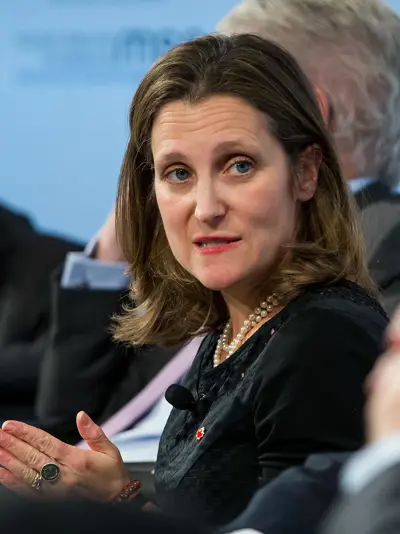
Christina Alexandra Freeland PC MP is a Canadian politician serving as the tenth deputy prime minister of Canada since 2019 and as the minister of finance since 2020. Freeland has held a number of portfolios over her tenure in government including minister of intergovernmental affairs, minister of foreign affairs, and minister of international trade. A member of the Liberal Party, Freeland represents the Toronto riding of University—Rosedale in the House of Commons. She is the first woman to hold the finance portfolio.
