Thomas Aquinas Quotes
Better to illuminate than merely to shine, to deliver to others contemplated truths than merely to contemplate.
Aquinas, Thomas. Summa Theologica. Translated by Fathers of the English Dominican Province, vol. 3, Benziger Brothers, 1918.


This was written when Islam was intellectually far more advanced than Christian Europe. This viewpoint was one of the reasons for their advanced civilization. It was held by many. It is still held by many Muslims, but for the fundamentalist of Islam today, ignorance of anything that is not in the Koran or other sayings of the Prophet is a virtue. Madrassas throughout the Islamic world teach only the Koran and religious law and nothing of mathematics, philosophy, science, history and never of other religions.

There was the beginning of a major debate in the advanced countries over the notion of copyright to protect authors and knowledge being a public property. The solution for America and most nations was to allow copyright protection for the specific expression of the knowledge but not the knowledge itself. You cannot copyright an idea or the laws of science—just the way they are expressed. Therefore all are free to discuss the knowledge and also write about it.
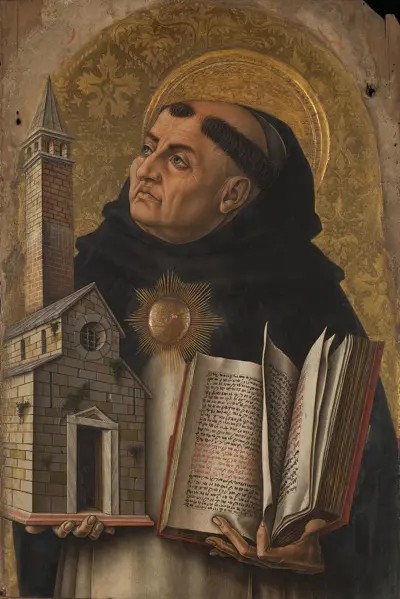
Thomas Aquinas was an Italian Dominican friar, philosopher, Catholic priest, and Doctor of the Church. An immensely influential philosopher, theologian, and jurist in the tradition of scholasticism, he is also known within the latter as the Doctor Angelicus, the Doctor Communis, and the Doctor Universalis. The name Aquinas identifies his ancestral origins in the county of Aquino in present-day Lazio, Italy. Among other things, he was a prominent proponent of natural theology and the father of a school of thought (encompassing both theology and philosophy) known as Thomism. He argued that God is the source of both the light of natural reason and the light of faith. His influence on Western thought is considerable, and much of modern philosophy developed or opposed his ideas, particularly in the areas of ethics, natural law, metaphysics, and political theory.
