Dwight D. Eisenhower Quotes
Before we can finalize our plans …
When Eisenhower first use this verb, many criticized him for his poor use of language. There was no such word at the time. Purists pointed out that something was final or it was not. There could not be a process of “finalizing”. Yet Eisenhower, with more experienced than most people developing at developing plans. He knew that in every large planning effort, there was a stage where the big decisions had been made and the plan details had to be amended to be consistent with the final decisions. When he called the process “finalizing” every person who had engaged in large planning efforts realized that this was an excellent term for a process that was a part of the planning process. To the distress of some grammarians and lingists, the term caught on and was used be virtually all planners thereafter. By the end if the 20th century, it was such a common and useful term that few people realized that before Eisenhower’s presidency the word “finalize” had never been used.
Dwight D. Eisenhower, 1890-1969, 34th President of the United States (Republican, KS), Supreme Allied Commander in Europe, First use ever of the word “finalize”, Quoted in Paul Dickson, Words from the White House
Sourced by: Eigen's Political and Historical Quotations


Whithead’s view which seems intuitively right to most citizens, tends to be the one that the majority espouses but the minority opposes. At the time, the Republicans controlled the White House and there were a number of polarizing issues, where the Republicans could not obtain consensus and then decided. However, then the Democrats gained control of the White House and Congress the next year, it was the Democrats who claimed that they had to decide. The Republicans, now in the majority, argued that significant changes in America should not be made by narrow majorities and major issues should be tabled if there was no substantial majority. That was the position that the Democrats had espoused when they were in the minority.

Adams urged paying tribute to the Barbary Pirates who had an incredible extortion racket going in the Mediterranean. If nations would pay them an annual sum each year, they would not attack and seize merchant ships of that country and sell the ships and goods while holding the sailors for ransom. Most of the European powers were paying the annual tribute as they calculated that it was cheaper than patrolling the Mediterranean with warships or going to war with the Barbary States. More important for Adams was that he did not think that the country would support such a military action. See {640847} That was Adams’ thinking. Jefferson however, sent our Navy and Marines to our first foreign war, and they were very effective. However, despite the American military victories, and because of the inability for the European powers to collaborate and share the burden of naval patrol, the United States went back to the craven policy of paying the blackmail. See {640846} & {640848}.


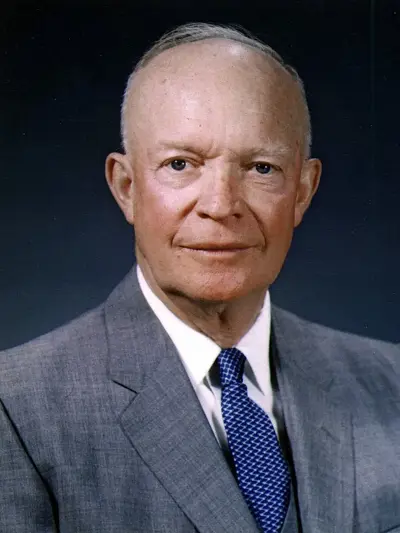
Dwight David "Ike" Eisenhower GCB OM GCS CCLH KC NPk was an American military officer and statesman who served as the 34th president of the United States from 1953 to 1961. During World War II, he became a five-star general in the Army and served as Supreme Commander of the Allied Expeditionary Force in Europe. He was responsible for planning and supervising the invasion of North Africa in Operation Torch in 1942–43 and the successful invasion of Normandy in 1944–45 from the Western Front.
